
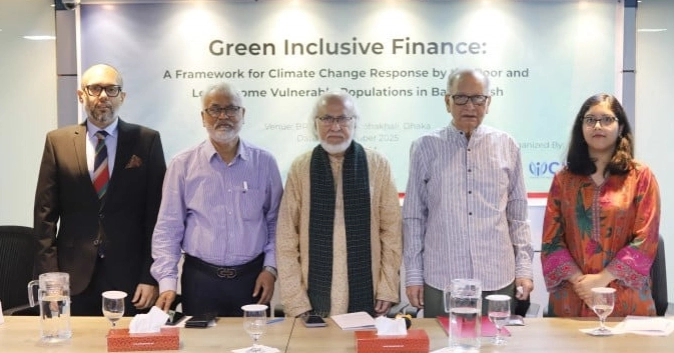
Policymakers and development specialists on Tuesday urged the adoption of a national framework on green inclusive finance to simultaneously promote financial inclusion and climate resilience among poor and low-income populations in Bangladesh.
They made the call at a discussion titled “Green Inclusive Finance: A Framework for Climate Change Response by the Poor and Low-Income Vulnerable Populations in Bangladesh”, jointly organised by the Institute for Inclusive Finance and Development (InM) and the Centre for Inclusive Development Dialogue (CIDD) at the BRAC Centre Inn in the capital.
The session was chaired by InM Chairman Dr Q.K. Ahmad.
Presenting the keynote paper, InM Executive Director and CIDD Chairman Dr Mustafa K. Mujeri proposed a strategic framework linking poverty reduction, financial inclusion and climate response through three pathways—resilience, adaptation and transition.
He noted that addressing climate change and supporting vulnerable communities cannot be treated as separate agendas.
A green inclusive financial system would enable low-income households to absorb climate shocks while gradually shifting towards more sustainable and resilient livelihoods, he added.
A panel discussion followed, featuring former Director General of the NGO Affairs Bureau Md Rashadul Islam and Research Analyst at Change Initiative Kazi Kareena Arif.
They highlighted that disadvantaged communities often remain excluded from conventional climate adaptation policies and financing mechanisms, leaving them disproportionately exposed to environmental risks.
The panel underscored the need for tailored financial instruments such as microfinance, microinsurance, flexible savings schemes, emergency credit facilities and well-targeted social safety nets to strengthen resilience among climate-risk-prone populations, particularly in coastal, haor and flood-affected regions.
Participants from financial institutions, microfinance organisations, development agencies and policy bodies also shared implementation strategies for advancing green inclusive finance at both institutional and grassroots levels.
The meeting concluded with a call for coordinated national planning, increased local participation and focused investments in climate-vulnerable areas to ensure that the transition towards climate resilience is inclusive and leaves no community behind.
A vote of thanks was delivered by Arsalan Zaman, Trustee of CIDD.