
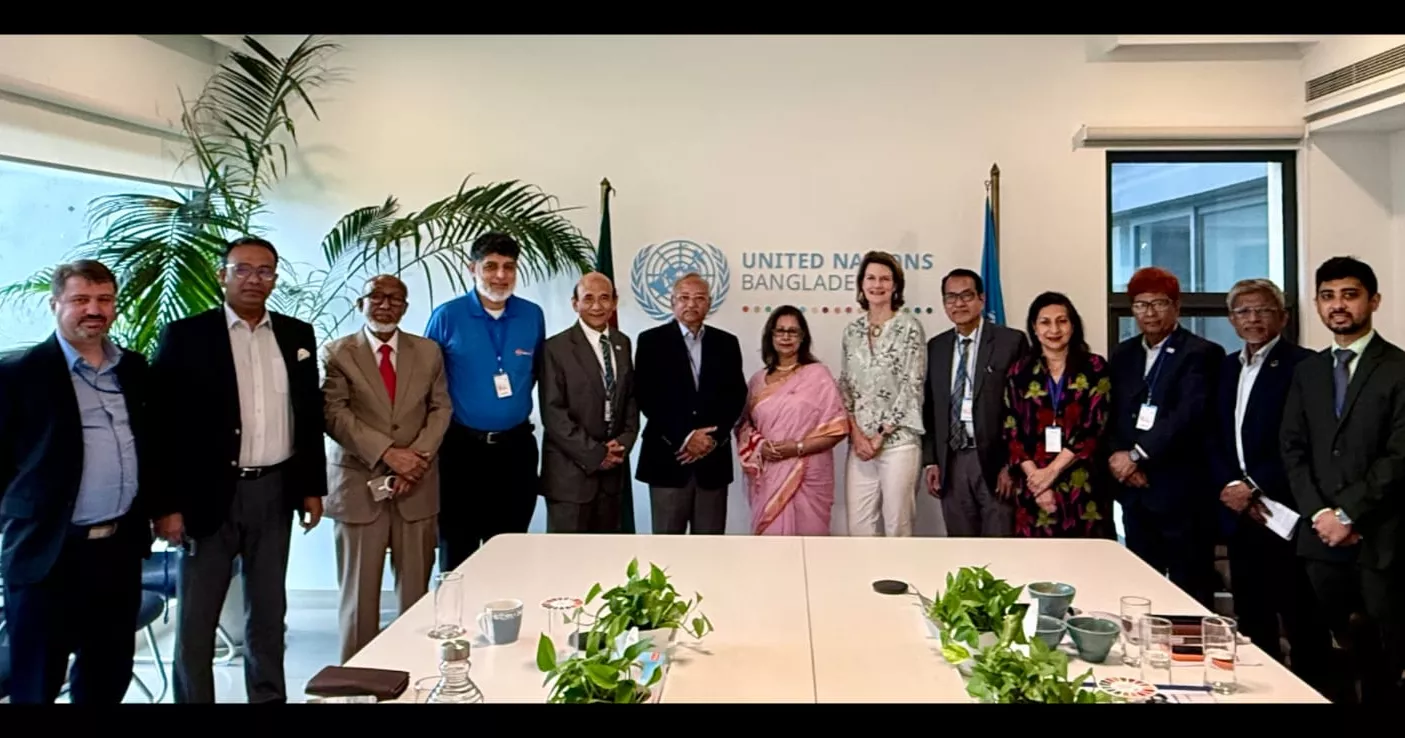
The Federation of Bangladesh Chambers of Commerce and Industry (FBCCI) and the United Nations Office for the Coordination of Humanitarian Affairs (UN OCHA) held a high-level meeting on Sunday at the UN House in Dhaka to explore ways to deepen private sector engagement in the country's humanitarian and disaster response architecture.
The meeting was led on the UN side by Lisa Doughten, Director of the Financing and Outreach Division at UN OCHA, who underscored that Bangladesh and Myanmar remain among the organisation's priority countries in Asia.
Discussions centred on how the private sector can be more strategically integrated into established global humanitarian frameworks, including the Central Emergency Response Fund (CERF), Country-Based Pooled Funds, and the Humanitarian Response Plan (HRP).
FBCCI's recent admission as the 22nd member of the Connecting Business Initiative (CBI), a joint platform run by UN OCHA and UNDP drew particular attention, with both sides acknowledging it as a meaningful step toward institutionalising private sector participation across all phases of disaster management.
The two sides identified concrete areas for structured cooperation, including joint training on humanitarian coordination mechanisms such as the Cluster System and Humanitarian Country Team processes, pilot initiatives for private sector-led emergency coordination, covering rapid response, resource mobilisation and business continuity and the integration of the FBCCI Safety Council into national and global coordination platforms.
Gender-sensitive and inclusive humanitarian action also featured prominently in the discussions, with emphasis on the private sector's role in supporting women-led enterprise recovery, bolstering the MSME sector and ensuring equitable access to relief supplies.
Both parties agreed to explore the formation of a sector-specific private sector humanitarian coordination platform under the FBCCI Safety Council, which would facilitate early coordination and joint planning in crisis situations.
Concluding the meeting, both sides committed to building a scalable private sector–humanitarian partnership model in Bangladesh, one they agreed could serve as a replicable example at the global level.
Among those present from the private sector were MCCI President Kamran T. Rahman, PRAN-RFL Group Chairman Ahsan Khan Chowdhury, FBCCI Secretary General Md Alamgir, and FBCCI Safety Council Adviser Brigadier General (retd) Abu Naeem Md Shahidullah, alongside other senior FBCCI officials.