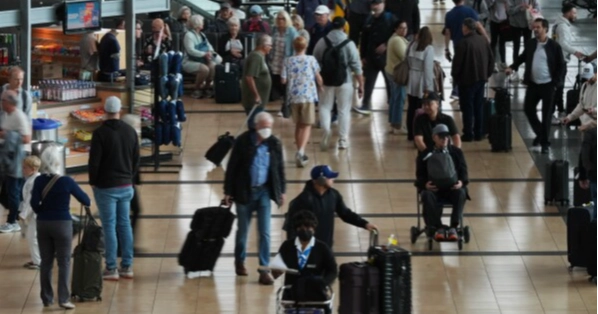
U.S. airlines canceled more than 2,500 flights over the weekend as the Federal Aviation Administration (FAA) continued to scale back air traffic operations amid the ongoing government shutdown, officials said Saturday.
The agency’s reduced capacity order — aimed at coping with unpaid and overworked air traffic controllers — has begun to disrupt some of the country’s busiest airports, deepening the fallout from what has become the nation’s longest federal shutdown.
“We all travel. We all have somewhere to be,” said Emmy Holguin, 36, waiting for a Miami-to-Dominican Republic flight. “I’m hoping the government can take care of this.”
Analysts warn that if cancellations keep growing into Thanksgiving week, the disruptions could ripple far beyond air travel, squeezing tourism, supply chains, and holiday shipping.
Cancellations surge as staffing thins
Flight-tracking site FlightAware reported more than 1,500 cancellations Saturday, following over 1,000 on Friday, with another 1,000-plus flights already canceled for Sunday.
Major airports in Atlanta, Chicago, Charlotte, and Newark were hit hardest, with delays spreading along the East Coast due to radar and tower staffing shortages.
Drone sighting briefly halts flights at Berlin airport
The FAA said the current flight reductions affect about 4% of commercial operations across 40 airports — a figure expected to rise to 10% by Friday if the shutdown drags on. Transportation Secretary Sean Duffy warned that deeper cuts could follow.
Controllers working without pay
Many controllers have gone without pay for nearly a month, forcing some to call in sick or take second jobs. Others are working mandatory six-day weeks with no pay, according to the National Air Traffic Controllers Association (NATCA).
On Saturday, the union said it delivered 1,600 handwritten letters to Congress urging lawmakers to end the shutdown.
Travelers stranded and frustrated
Although most passengers have been able to rebook, uncertainty remains about future cancellations. “Travel is stressful enough. Then you put these disruptions in place, and it really makes everything more challenging,” said Heather Xu, 46, flying home to Puerto Rico after a cruise.
Some travelers canceled plans altogether. Diana Alvear of New Jersey said her family scrapped their trip to California over safety and disruption concerns. While United Airlines refunded the airfare, she said they lost a $700 Airbnb deposit.
“This has been costly and disappointing,” Alvear said. “It’s really weighing on our hearts.”
Economic ripple effects
Experts warned that disruptions could soon hit consumers’ wallets. Nearly half of U.S. air freight travels in passenger plane cargo holds, meaning flight cuts could push up shipping costs and retail prices.
Pakistan’s PIA resumes UK flights after five-year ban
“This shutdown will impact everything — from business travel to tourism to local tax revenue,” said Greg Raiff, CEO of Elevate Aviation Group. “It’s a cascading effect.”
Patrick Penfield, a supply chain professor at Syracuse University, said the longer the shutdown lasts, “the more likely we are to see the economic pain extend beyond airports and into everyday life.”
Source: AP