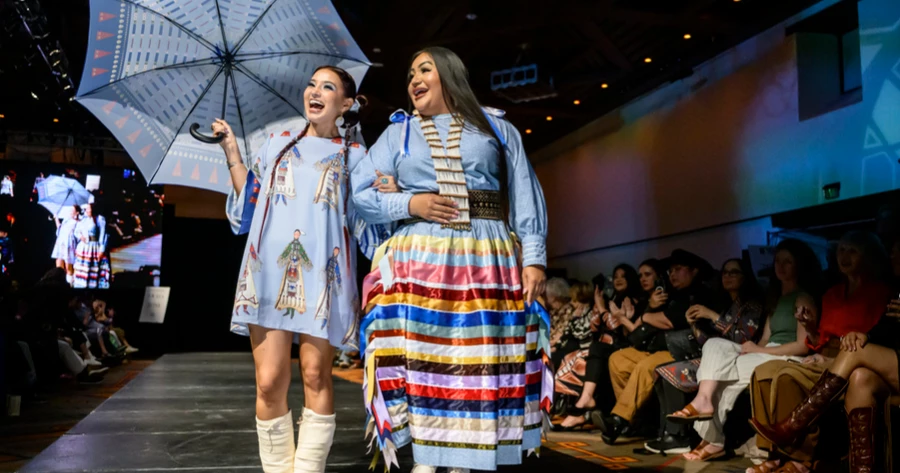
Indigenous fashion designers from across North America are showcasing clothing inspired by their cultural roots and daily lives during a three-day fashion event that began Friday in Santa Fe, a key center for Native art and creativity.
The event, which is part of the historic Santa Fe Indian Market, has joined forces with Vancouver Indigenous Fashion Week this year, highlighting unity and creative expression among Indigenous artists. An additional independent show in the city’s railyard district has nearly doubled the activity behind the scenes, with models, makeup artists, and final preparations in full swing.
Runway shows will feature a mix of professional and family models, Indigenous dancers, and public figures, all presenting designs accompanied by music. The garments range from flowing silks to traditional animal hides, embellished with beadwork, ribbons, and jewelry. Contemporary styles include digitally crafted designs and urban streetwear with Native influences, especially from Phoenix.
Patricia Michaels, a Taos Pueblo designer and former "Project Runway" contestant, said Indigenous fashion is a way to express both personal identity and community ties. “Designers are sharing what drives them — their heritage and lived experience,” she said.
A Santa Fe Tradition Evolves
The spring fashion week is a newer addition to Santa Fe’s art calendar, evolving from the high-fashion elements of the city’s long-standing summer Indian Market, which attracts massive crowds for its display of Native artwork.
Designer Sage Mountainflower, who grew up attending the Indian Market with her artist parents in the 1980s, left a career in environmental policy to pursue fashion. She began by creating regalia for her children and eventually gained international acclaim. Now 50, she is unveiling her “Taandi” collection — meaning “Spring” in the Tewa language — featuring satin and chiffon garments with embroidered designs rooted in her heritage from Ohkay Owingeh Pueblo, Taos Pueblo, and the Navajo Nation.
“I follow trends a little, but mostly I go with what I love,” Mountainflower said. “This collection is about how spring transforms around us — it’ll be vibrant and full of color.”
Over 20 designers are participating by invitation from the Southwestern Association for Indian Arts. Fashion is an essential part of Santa Fe’s broader creative culture, supported by local vendors, academic programs at the Institute of American Indian Arts, and daily arts markets in the city center.
Fashion designers this week have been honored at events including a gala at the governor’s mansion, social gatherings in galleries and bookstores, and pop-up shops selling runway pieces.
Cross-Border Collaboration
The partnership with Vancouver Indigenous Fashion Week brings Canadian First Nations designers into the spotlight. Secwépemc artist Randi Nelson traveled from Whitehorse, Yukon, to present clothing made from elk and caribou hides, using traditional tanning methods passed down through her family.
“There’s no one-size-fits-all Indigenous fashion,” said Nelson, a member of the Bonaparte/St’uxwtéws First Nation. “Each designer draws from their own nation’s teachings and reinterprets them in a contemporary way.”
Urban Indigenous Style
Phoenix-based designer and jeweler Jeremy Donavan Arviso is adding a bold, streetwear perspective to the shows, aiming to push Santa Fe’s fashion scene onto the global stage. A panel discussion on Thursday addressed rising tariffs and supply costs, along with the tension between fast fashion and Indigenous values of sustainability.
Arviso, who has Diné, Hopi, Akimel O’odham, and Tohono O’odham roots, said his fashion reflects his upbringing in Phoenix more than traditional ceremonial influences. “I didn’t grow up with those customs — I grew up on the streets,” he said, comparing his style to musical sampling in early hip-hop.
He’s debuting his “Vision Quest” collection, introduced by Toronto-based ballet dancer Madison Noon in a dramatic performance.
Prominent figures walking the runway include former U.S. Interior Secretary Deb Haaland of Laguna Pueblo, dressed in designs by Patricia Michaels and jewelry by Zuni Pueblo artist Veronica Poblano.