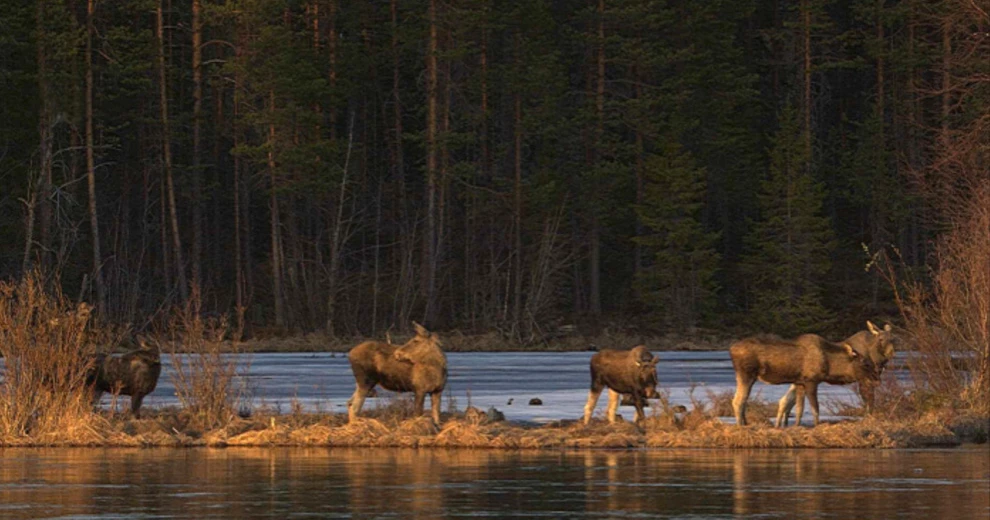
Before Sweden’s beloved slow TV series The Great Moose Migration returned on Tuesday, 62-year-old Ulla Malmgren made sure she was fully prepped—stocked with coffee and pre-cooked meals. She’s in it for the long haul, not wanting to miss a second of the 24/7 broadcast that spans 20 days.
“Sleep? That’s off the table. I just don’t sleep,” she admitted.
Malmgren is far from alone. Known in Swedish as Den stora älgvandringen—and sometimes translated into English as The Great Elk Trek—this unique nature show launched in 2019 with nearly a million viewers. By 2024, it had drawn over 9 million streams on SVT Play, Sweden’s national broadcaster’s streaming platform.
Due to warmer weather triggering early moose movement, the livestream began ahead of schedule this year. Malmgren was ready.
Running through May 4, remote cameras are set up to track dozens of moose as they cross the Ångerman River, about 300 km (187 miles) northwest of Stockholm, making their annual journey to lush summer feeding grounds.
Though hours can pass without much activity, fans say the slow pace is exactly what draws them in.
“I feel super calm, but also hyper-aware—like, ‘Was that a moose?! What if one shows up? I can’t leave for the bathroom!’” said 20-year-old William Garp Liljefors, who’s amassed over 150 moose plushies since becoming a fan in 2020.
The Rise of Slow TV
The Great Moose Migration follows in the footsteps of slow TV programming that began in 2009 with a real-time broadcast of a seven-hour Norwegian train ride by NRK. Since then, the concept has caught on globally, with similar programs airing in the UK, China, and beyond. In the Netherlands, a "fish doorbell" livestream lets viewers signal officials when migrating fish are blocked by a lock.
Annette Hill, a media and communications professor at Sweden’s Jönköping University, says slow TV echoes reality TV—but without the artificial drama. It offers a peaceful, authentic experience that unfolds in real time.
“It’s oddly captivating,” Hill said. “There’s no chaos, no spectacle—just quiet beauty moment by moment.”
As both a media scholar and a fan, Hill says the show helps her unwind and reconnect with the seasonal rhythms of nature.
“It creates a serene, atmospheric vibe at home, which I love,” she said.
Bringing Nature Home
Even the show’s production team benefits from its calming effect, according to SVT project manager Johan Erhag.
“Everyone who works on it feels their stress levels drop,” he said.
The migration route has been used by moose for generations, making it easy for the production crew to know where to install nearly 12 miles (20,000 meters) of cable and strategically place 26 daytime and seven night cameras, plus a drone for aerial shots.
A small team of about 15 people produces the show remotely from a control room in Umeå, ensuring they don’t disrupt the animals.
SVT doesn’t disclose the show's exact budget, but Erhag says it’s relatively low-cost, especially given last year’s 506 hours of broadcast footage.
Swedes have long been intrigued by the country’s estimated 300,000 moose—huge but elusive creatures known as “Kings of the Forest.” Adult bulls can stand nearly 7 feet tall at the shoulder and weigh close to 1,000 pounds, yet they are typically solitary and shy.
“Most people rarely see one in real life—maybe once or twice while driving,” Erhag said. “That’s part of the appeal. And now, we’re bringing them into everyone’s living room.”
A Passionate Following
Viewer Hanna Sandberg, 36, started watching in 2019 but didn’t spot any moose her first year. She returned in 2020, finally saw some, and became a dedicated fan.
“Watching them in their natural environment like this—it’s something you just can’t experience otherwise,” she said.
When a moose finally steps into frame after hours of stillness, the mood instantly shifts. SVT sends out a push alert—“Första älgarna i bild!” or “First moose on camera!”—and viewers flock to the stream, cheering on the animal in real time.
“I’d love to be a fly on the wall in every living room watching,” said Malmgren. “I bet a million people are shouting the same thing: ‘Go on! You’ve got this!’”
Malmgren is part of a Facebook group with over 76,000 other fans, all committed to catching as many hours as possible.
Liljefors recalled being late for school after spotting moose on the stream. “My teacher thought I saw one in the city. I was like, ‘No, on TV!’”
Malmgren says her friends and family know better than to interrupt during migration season.
“If someone asks what I’m doing, they stop themselves: ‘Oh, never mind—it’s the migration,’” she said with a laugh.