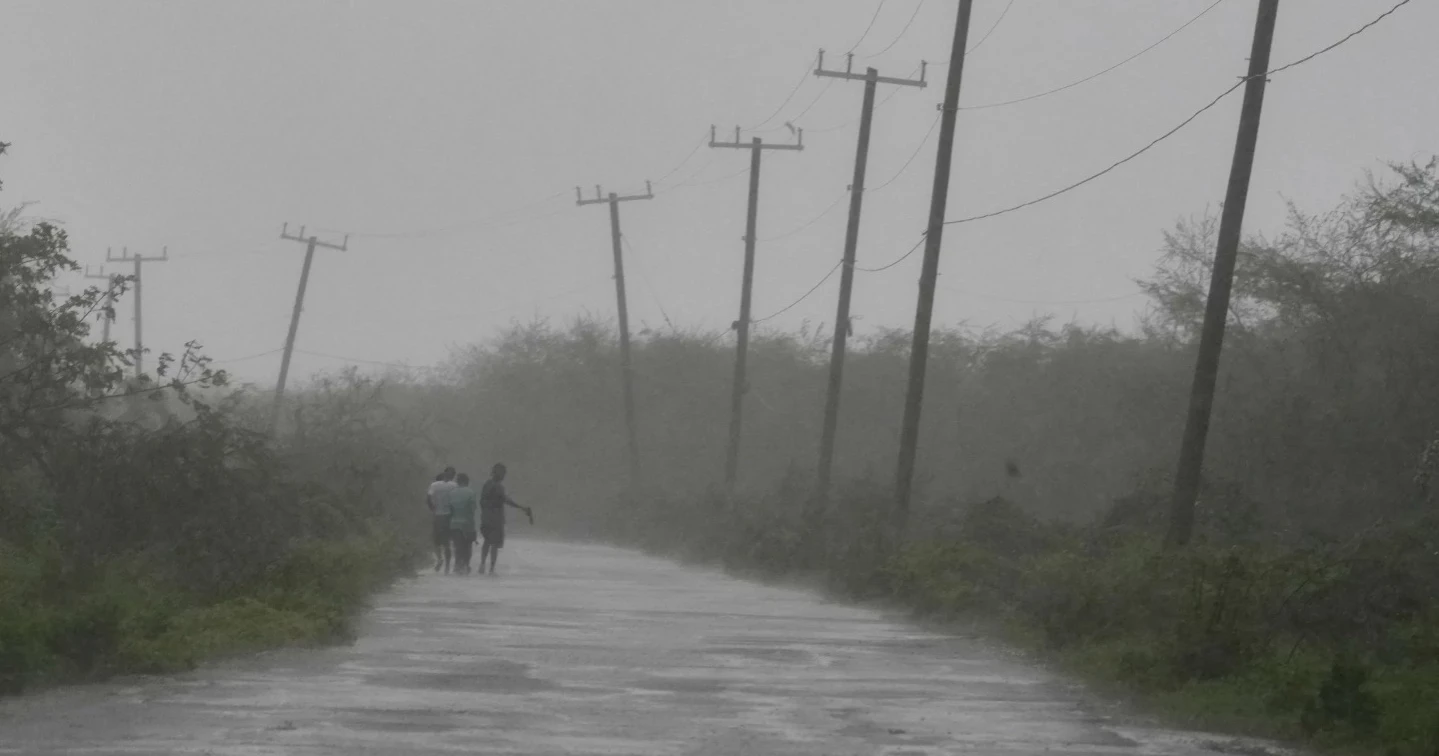
Powerful winds ripped roofs from homes, boulders rolled across roads, and floodwaters inundated southwestern Jamaica on Tuesday as Hurricane Melissa — a Category 5 monster storm — battered the Caribbean island, ranking among the strongest Atlantic hurricanes ever recorded.
Officials reported widespread power outages, landslides, and fallen trees as the hurricane made landfall near New Hope with sustained winds of 185 mph (295 kph). Prime Minister Andrew Holness said no infrastructure in the country could withstand such force.
“The real question now is how fast we can recover. That’s the challenge,” Holness told reporters.
In the western community of Black River, rising waters trapped at least three families inside their homes, but emergency teams were unable to reach them due to dangerous conditions, said Desmond McKenzie, deputy chairman of the Disaster Risk Management Council.
“Roofs were flying off,” he said. “We’re hoping the situation improves so rescuers can reach those affected.”
The St. Elizabeth parish in southwestern Jamaica was reportedly “underwater,” McKenzie added. Authorities said it was still too early to assess the full extent of damage as Melissa — the strongest storm to strike the island since recordkeeping began 174 years ago — continued to lash the country.
Meteorologist Rohan Brown warned that Melissa’s counterclockwise winds would push a dangerous storm surge into northern Jamaica overnight, even as the system weakened slightly to Category 4 while tracking toward Cuba.
Officials said nearly 15,000 Jamaicans were sheltering in government facilities, while 540,000 customers — about 77% of the island — were without power.
Although authorities repeatedly urged residents to stay indoors, a few curious teenagers ventured out to witness the storm’s fury.
“When the wind howls, it feels like the world is falling apart,” said 15-year-old Gavin Fuller, grinning nervously.
Elsewhere, Colin Bogle, an adviser with Mercy Corps, sheltered with his grandmother in Portmore as power failed across the neighborhood.
“The noise is relentless,” he said. “People are anxious and just trying to hold on until it’s over.”
By Tuesday night, Melissa’s sustained winds had dropped to 130 mph (215 kph) as it moved northeast at 9 mph (15 kph), centered roughly 110 miles (175 km) southwest of Guantánamo, Cuba, according to the U.S. National Hurricane Center.
At its peak, Melissa’s 185 mph winds and central pressure of 892 millibars tied two all-time Atlantic records — matching the 1935 Labor Day hurricane in Florida and 2019’s Hurricane Dorian, hurricane experts Phil Klotzbach and Brian McNoldy confirmed.
“It’s been a remarkable, beast of a storm,” Klotzbach told the Associated Press.
With a storm surge of up to 13 feet (4 meters) predicted, authorities expressed concern for hospitals along the coast. Four major hospitals were damaged, and one lost power, forcing the evacuation of 75 patients, McKenzie said.
Amid the chaos, a radio station received a distress call from a man seeking help for a woman in labor in western Jamaica. Listeners and medical professionals joined live on air to guide him through emergency procedures.
In Kingston, officials even warned residents to watch for crocodiles displaced by floodwaters.
Rescue teams with boats and helicopters were on standby to begin operations as soon as conditions allowed, McKenzie added.
The storm has already claimed at least seven lives across the Caribbean — three in Jamaica, three in Haiti, and one in the Dominican Republic — with another person missing.
Authorities were meeting Tuesday night to plan debris clearance and emergency aid distribution, hoping to reopen airports by Thursday, said Richard Thompson, acting head of the island’s emergency management office.
U.N. agencies and humanitarian groups had pre-positioned food, medicine, and relief supplies to support recovery once the storm passed.
Melissa takes aim at Cuba
The hurricane was expected to make landfall in eastern Cuba early Wednesday, bringing up to 20 inches (51 cm) of rain and a significant coastal surge.
Cuban President Miguel Díaz-Canel, in a televised address, urged citizens not to underestimate the storm’s power, calling it “the strongest ever to hit national territory.”
In Santiago de Cuba, residents rushed to secure homes and livestock while thousands sought shelter inland. Eduviges Figueroa, 83, said she had opened her home at the foot of the Sierra Maestra mountains to those fleeing.
“We’re helping as best we can,” she said. “Now I’m cooking for everyone.”
As 200,000 people were evacuated from Holguín province and nearby towns, Diamon Mendoza, a 36-year-old mother, voiced the fear shared by many:
“May God have mercy on us. It’s coming with tremendous force — anything can happen.”
Source: AP