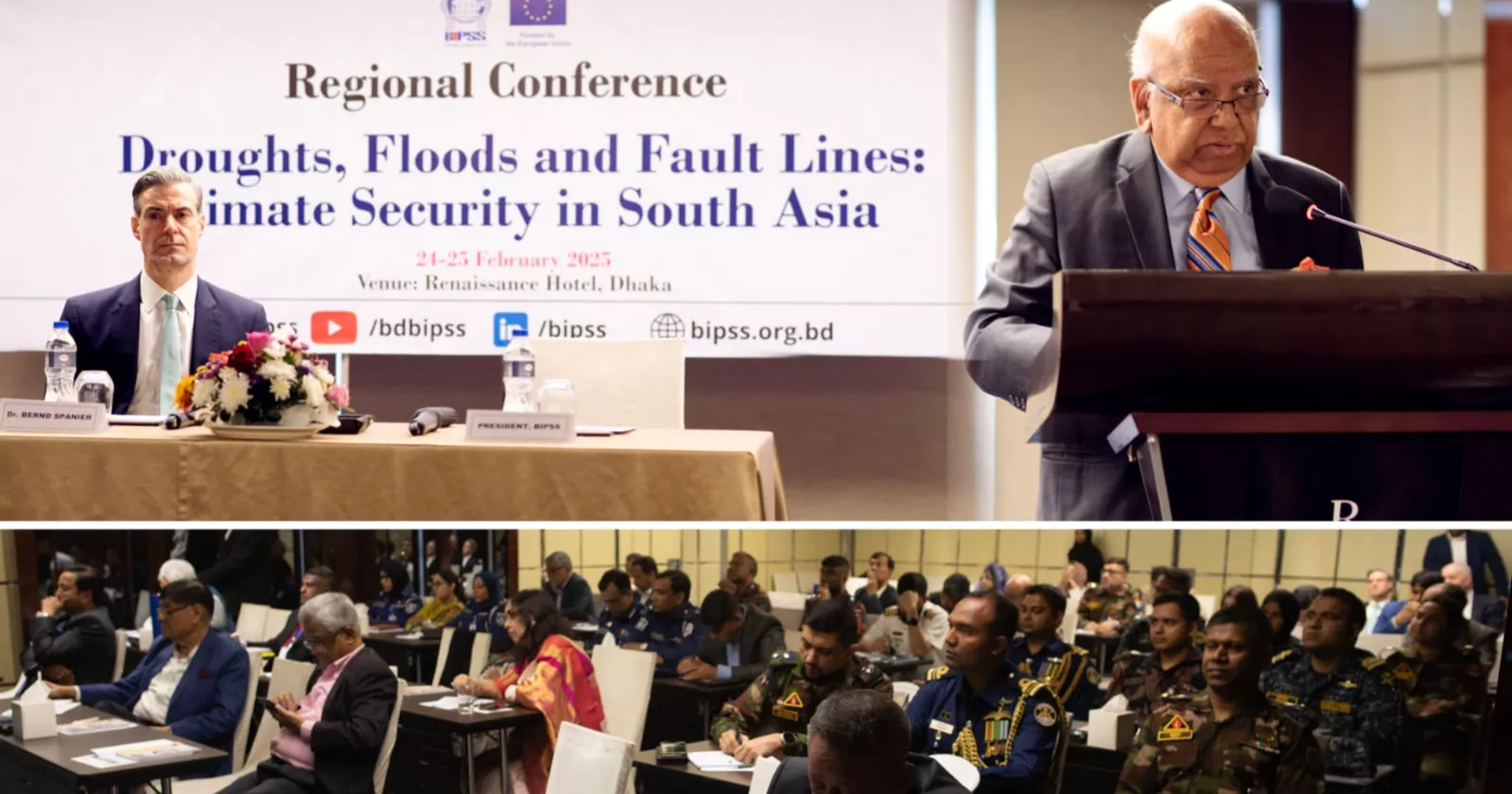
A regional conference titled “Droughts, Floods, and Fault Lines: Climate Security in South Asia,” was held recently at the Renaissance Hotel in Dhaka.
The event, organised by The Bangladesh Institute of Peace and Security Studies (BIPSS) and funded by the European Union, brought together policymakers, experts, and key stakeholders from six countries—Nepal, Bhutan, Pakistan, Sri Lanka, India, and Bangladesh—to engage in high-level discussions on the intersection of climate change and security in the South Asian region.
Major General A N M Muniruzzaman, president of BIPSS, emphasized the global significance of climate security and urged for collective action to combat climate-related challenges.
Dr. Bernd Spanier, Deputy Head of Delegation, European Union to Bangladesh, was the special guest of the conference.
He recalled a quote by the former UN secretary general Ban Ki-moon: “Climate change is a threat multiplier for instability in conflict" and also highlighted the role of security experts in climate discussions in his speech.
He also appreciated the much-needed collaboration between climate and security matters and called for enhanced cooperation between civil society and security forces regarding climate security.
During the conference, multiple sessions featured distinguished speakers addressing various aspects of climate security.
The first session of the first day of the conference was moderated by Prof. Mizan R Khan, Technical Lead, LDC Universities Consortium on Climate Change (LUCCC), LDC Group under UNFCCC.
He explored the role of the security sector in climate security.
Dr. Salma Malik, Professor and Director of External Linkages, Quaid-I-Azam University, Pakistan, highlighted the urgent need for South Asian nations to prioritize climate cooperation over political differences.
She shared some of the alarming factors of climate change on the basis of the situation in Pakistan. She said that without a secure planet, peace is unattainable, quoting, “We must listen to what the climate is telling us.”
Parvez Karim Abbasi, assistant professor at East West University, delved into the links between climate security, food stability, and renewable energy.
Day two of the conference commenced with opening remarks from Mr. Shafqat Munir, Senior Research Fellow at BIPSS. He reflected on the discussions from the previous day and highlighted some important parts from it.
Bharat Bhushan, South Asia Editor at 360 Info, hosted by Australian National University, spoke on “Water Wars or Water Wisdom? Climate Security Through Resource Sustainability.”
He highlighted the complexities of transboundary water-sharing issues in South Asia, referencing various water treaties of the region.
He emphasized the political constraints that hinder successful water agreements in the region and called upon stronger bodies to facilitate these.
After that, Iffat Anjum, Assistant Professor at the Department of International Relations, Bangladesh University of Professionals, delivered a presentation on “Fleeing the Storm: Climate Security and Migration in South Asia.” She discussed her research on climate-induced migration in Bangladesh, examining the interplay between migration, climate, and security. She advocated for a more human-centric approach to climate security.
During the final session Shafqat Munir highlighted the need for a South Asian common approach towards climate security.
Speaking on “Climate Chaos, Border Tensions: Navigating Climate Security in a Warming World,” Major General Binaj Basnyat, Strategic Analyst (Retired), Nepalese Army, focused on the geopolitical and strategic dimensions of climate security.