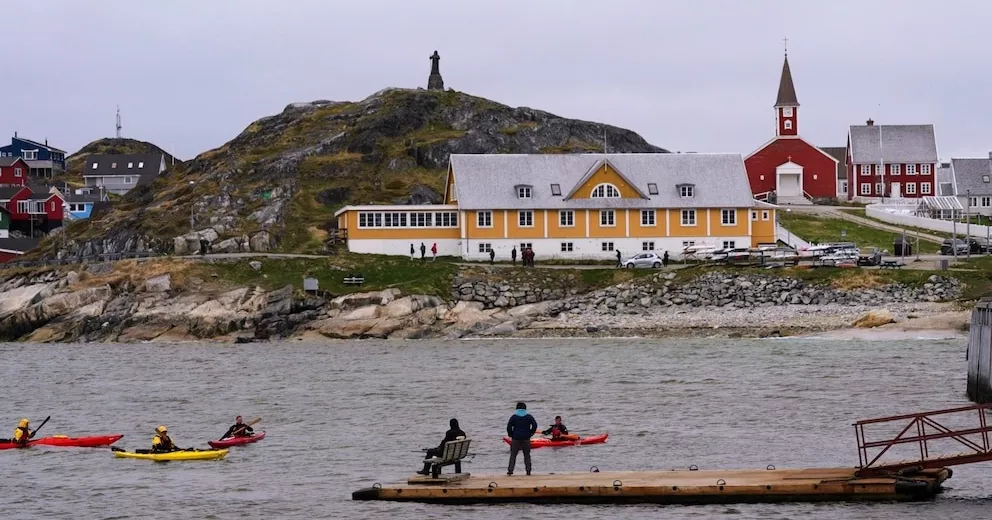
Because of harsh environment in Greenland, lack of key infrastructure and difficult geology have so far prevented anyone from building a mine to extract the sought-after rare earth elements that many high-tech products require. Besides President Donald Trump prevails in his effort to take control of the arctic island, those challenges won’t go away.
Trump has made reducing China’s dominance over the global rare earth supply a top priority since the world’s second-largest economy sharply limited access to those materials after the United States imposed broad tariffs last spring. His administration has poured hundreds of millions of dollars into the sector and has even acquired stakes in several companies. Now, the president is suggesting that taking control of Greenland from Denmark could be the answer.
“We are going to do something on Greenland whether they like it or not,” Trump said Friday.
Greenland is unlikely to produce rare earths anytime soon, if at all. Although some companies are exploring its estimated 1.5 million tons of deposits, most projects remain at an early stage. Trump’s interest in the island may be driven more by efforts to counter Russian and Chinese influence in the Arctic than by access to rare earths like neodymium and terbium used in advanced technologies.
“The fixation on Greenland has always been more about geopolitical posturing — a military-strategic interest and stock-promotion narrative — than a realistic supply solution for the tech sector,” said Tracy Hughes, founder and executive director of the Critical Minerals Institute. “The hype far outstrips the hard science and economics behind these critical minerals.”
Trump confirmed those geopolitical concerns at the White House Friday.
Read More: Trump threatens to take Greenland by force
“We don’t want Russia or China going to Greenland, which if we don’t take Greenland, you can have Russia or China as your next door neighbor. That’s not going to happen,” Trump said
A difficult place to build a mine
Mining in Greenland faces major hurdles, including extreme remoteness, limited infrastructure, environmental risks, and harsh weather. Rare earths there are locked in complex eudialyte rock with no proven profitable extraction method. While Critical Metals’ shares jumped after plans for a pilot plant, it and other companies remain far from building a mine and would need massive investment.
Producing rare earths is a tough business
Even the most promising rare earth projects can struggle to be profitable, especially when China floods the market with excess supply to lower prices and push competitors out, a tactic it has used repeatedly. Currently, most critical minerals are still processed in China.
The U.S. is rushing to increase rare earth supplies outside China during a one-year easing of stricter restrictions that Trump said Xi Jinping agreed to in October. Several companies worldwide are already producing rare earths or magnets and can bring them to market faster than Greenland, which Trump has threatened to take militarily if Denmark refuses to sell it.
“There are very few folks that can rely on a track record for delivering anything in each of these instances, and that obviously should be where we start, and especially in my view if you’re the U.S. government,” said Dunn, whose company is already producing more than 2,000 metric tons of magnets each year at a plant in Texas from elements it gets outside of China.