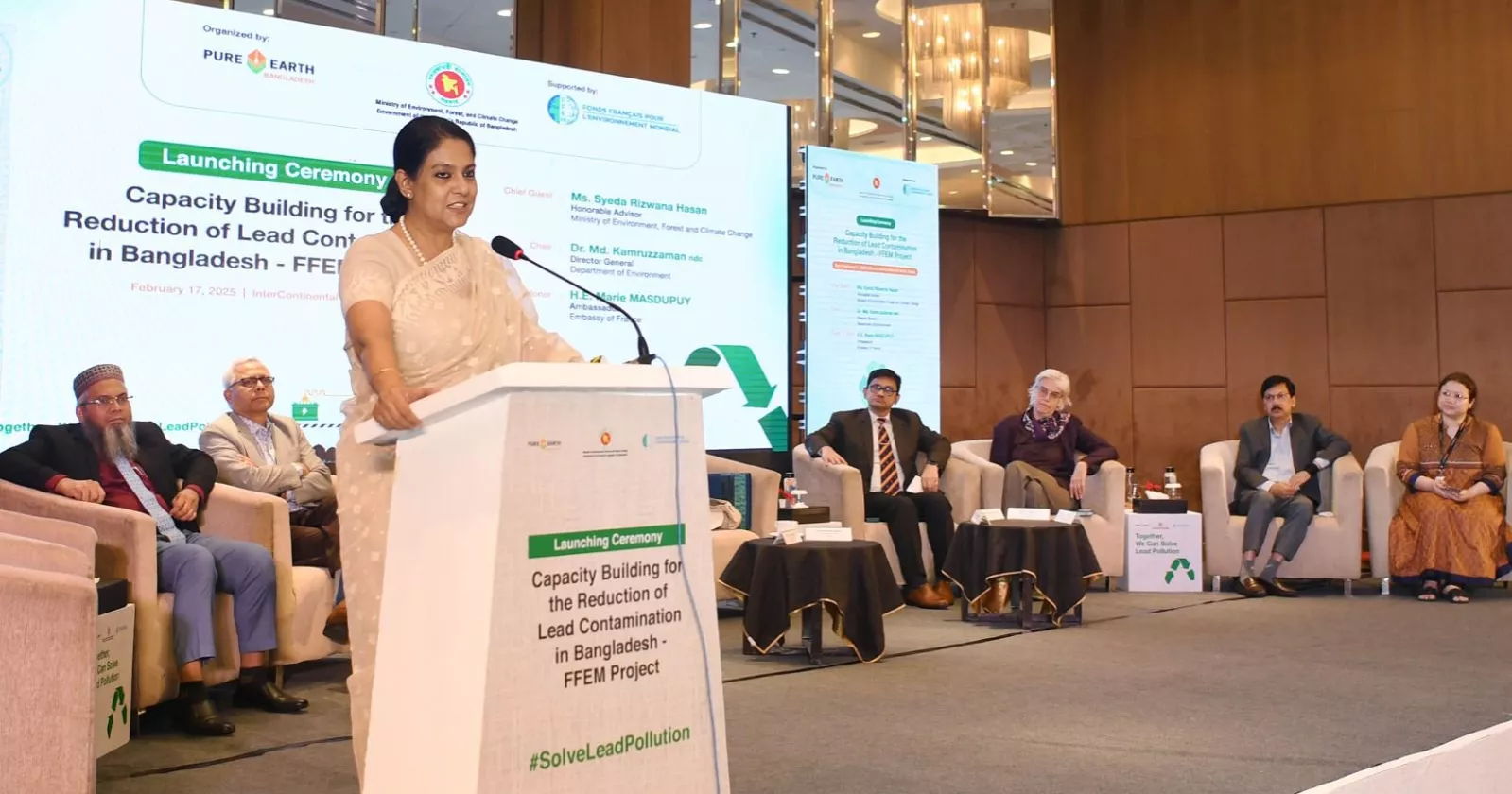
Syeda Rizwana Hasan, Adviser to the Ministry of Environment, Forest and Climate Change and the Ministry of Water Resources, stressed on Monday that industries must be held responsible for pollution control and should be trained in remediation plans.
“The responsibility of pollution control cannot rest solely with the government; industries must actively participate in cleaning up pollution,” she said.
Addressing as the chief guest the launching ceremony of the "Capacity Building for the Reduction of Lead Contamination in Bangladesh" at Hotel Intercontinental, Dhaka, she emphasised the urgent need for stricter regulations and industry accountability in tackling lead contamination in Bangladesh, said a media release sent from her ministry.
Rizwana highlighted that with support from international partners like France, the Department of Environment now has the capacity to develop a time-bound action plan to tackle lead pollution. “While taking immediate action against all polluting industries may not be feasible, we must at least address those operating without environmental clearance.”
She clarified that the goal is not to shut down industries but to ensure compliance by obtaining clearance, assessing their locations, and implementing remediation measures. Environmental clearance certificates should include mandatory periodic remediation actions, requiring industries to clean up their systems within a specific timeframe.
As a financial accountability measure, she suggested creating a pollution remediation fund. Industries would deposit an amount that would be reimbursed upon successful remediation, while failures would result in the government utilizing the funds for cleanup efforts.
Shipbreaking must not continue at the expense of human lives: Rizwana
To strengthen monitoring and enforcement, she stressed the need for community involvement. While enforcement must remain under government control, community members should be engaged in monitoring environmental compliance.
She also emphasised the importance of including the National Board of Revenue (NBR) in the multi-stakeholder steering committee to facilitate the transition from lead-acid batteries to lithium-ion alternatives through revised taxation policies, according to it.
Additionally, medical professionals should be involved to highlight the health risks of lead contamination. Calling for urgent standardisation, she urged the Bangladesh Standards and Testing Institution (BSTI) to expedite setting pollution control standards, adopting global benchmarks where necessary.
“This initiative is crucial for public health and environmental protection. Lead contamination poses a severe risk, especially to children. A structured action plan will significantly reduce this threat and ensure a sustainable future,” she said.
Youth rally at CU: Crisis won't be resolved if investment in renewable energy not increased quickly
Dr Md. Kamruzzaman, Director General of the Department of Environment presided over the launching. Marie Masdupuy, Ambassador of French to Bangladesh spoke as the guest of honour. Sheikh Sayidul Haque, Addl. Director General (Planning and Development) of DGHS; Dr Tahmeed Ahmed, Executive Director, icddr,b; Maya Vandennent, Chief of Health, UNICEF Bangladesh, Mitali Das, Executive Director, Pure Earth Bangladesh and Sohanur Rahman, Executive Coordinator, YouthNet Global also spoke in the occasion.