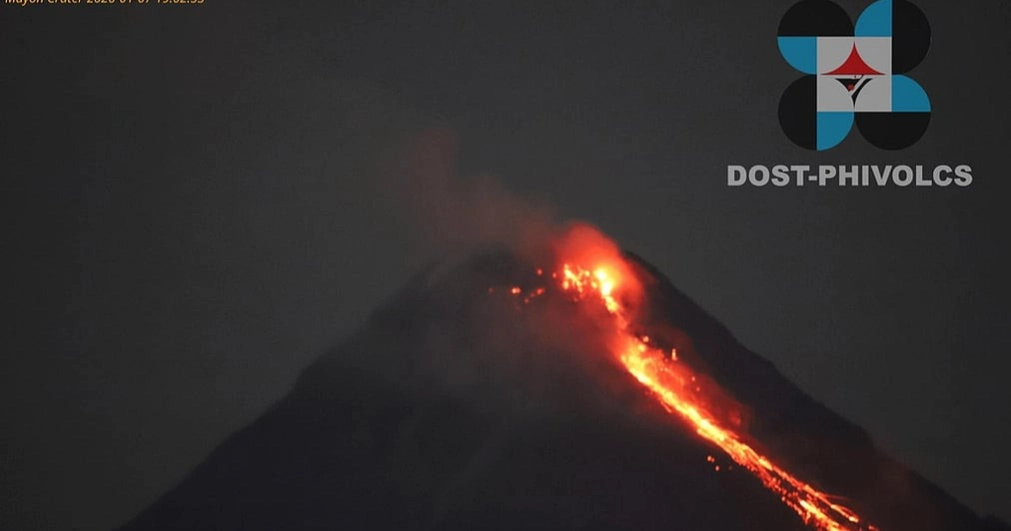
Heightened volcanic activity at Mayon Volcano, the most active volcano in the Philippines, has forced authorities to evacuate close to 3,000 people from high-risk areas on its slopes, officials said Wednesday.
The alert level for Mayon, located in Albay province in the country’s northeast, was raised to Level 3 on Tuesday after monitoring teams recorded repeated rockfalls from the summit crater, some comparable in size to vehicles, along with dangerous pyroclastic flows—rapid streams of superheated ash, gas and debris.
Under the country’s five-tier warning system, Level 5 signals a major explosive eruption accompanied by violent ash emissions and widespread fallout.
“This activity already qualifies as an eruption, though a relatively quiet one,” said Teresito Bacolcol, head of the Philippine Institute of Volcanology and Seismology. He explained that lava has been building up near the summit, causing the dome to expand and crack, leading to the observed rockfalls.
Bacolcol noted it remains uncertain whether the situation will escalate into a more violent eruption, as other critical indicators—such as increased volcanic earthquakes or high sulfur dioxide emissions—have not yet been detected.
Read More: Palm trees under the axe; Naogaon bypass pays an environmental price
With assistance from troops, police and disaster-response teams, authorities relocated more than 2,800 residents from 729 families living within a six-kilometer danger zone around the crater, an area permanently restricted due to its high risk, according to Albay provincial officials.
In addition, about 600 people living outside the permanent danger zone chose to evacuate voluntarily to government-run shelters, said Claudio Yucot, regional director of the Office of Civil Defense.
Despite longstanding prohibitions, many residents have continued to live or farm within the danger zone for generations, while activities such as quarrying and tourism have also persisted. Mayon has erupted 54 times since records began in 1616.
Standing 2,462 meters tall, Mayon is famed for its nearly perfect cone and is one of the country’s top tourist attractions. At the same time, it remains the most active among the Philippines’ 24 potentially active volcanoes.
A stark reminder of its destructive power is the lone bell tower of a 16th-century church still visible in Albay—what remains of a town buried during the catastrophic 1814 eruption that killed around 1,200 people.
The continued presence of communities within Mayon’s hazard zones highlights the broader challenge faced by many low-income Filipinos who live in disaster-prone areas across the archipelago. Located along the Pacific “Ring of Fire,” the Philippines also endures frequent earthquakes, volcanic eruptions and an average of 20 typhoons each year.