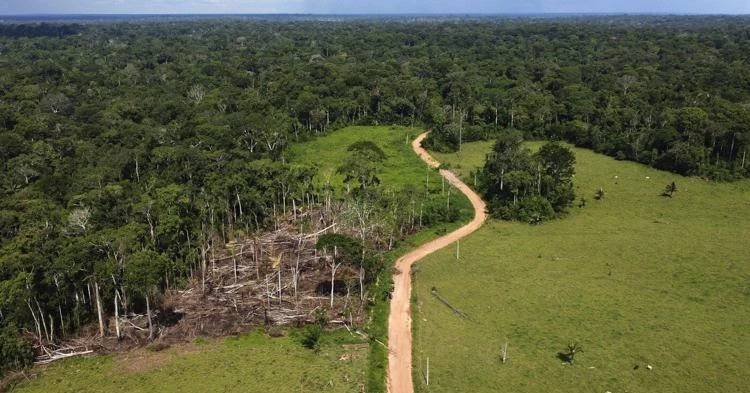
The removal of illegally raised cattle from protected public land in Brazil’s Amazon has triggered protests and divided opinions among local residents. Some community members want to protect traditional activities like rubber tapping and Brazil nut harvesting, while others support expanding livestock farming.
The government operation began last week in the Chico Mendes Extractive Reserve—an iconic conservation area named after the famed environmentalist and rubber tapper who was assassinated in 1988. Federal agents, supported by police and military personnel, confiscated around 400 cattle from two farmers who had ignored court-ordered eviction notices. Officials plan to carry out more such actions in the coming weeks.
However, many reserve residents opposed the operation and attempted to block cattle removal in the city of Xapuri, forcing the first truck, carrying 20 cattle, to take a different route to avoid clashes. The protest, backed by local politicians, was especially symbolic as Xapuri was where Mendes was murdered. The demonstration highlighted a stark shift from the 1980s, when rubber tappers like Mendes stood against cattle ranching in the Amazon.
The removal of cattle from Brazil’s Chico Mendes Extractive Reserve was triggered by a 56% increase in deforestation during the first five months of 2025 compared to the same period in 2024. The area of forest lost is nearly five times larger than New York City’s Central Park. Officials estimate that around 140,000 cattle are currently being raised within the reserve.
Power plant carbon emissions not dangerous: EPA
According to the Chico Mendes Institute for Biodiversity Conservation (ICMBio), the federal agency responsible for the reserve, the main cause of this environmental damage is large-scale cattle ranching, which violates the area's protected status. “Environmental monitoring has revealed that the destruction is primarily driven by illegal livestock farming on a large scale,” the agency said.
The Chico Mendes Reserve is part of a network of Amazonian extractive reserves designed to allow traditional forest communities to engage in sustainable activities like rubber tapping and small-scale farming, while shielding the land from commercial development. The rules prohibit land sales and restrict deforestation to minimal levels for subsistence farming and cattle raising. Despite these regulations, the Chico Mendes Reserve has become the most deforested federal conservation area in the country.
‘Working to find a solution’
The current problems worsened in the four-year term of far-right President Jair Bolsonaro that ran through 2022, when deforestation exploded in the reserve. Bolsonaro defanged environmental protection and said the Amazon had too many protected areas. Some residents of Chico Mendes began selling their land parcels illegally to farmers, who hoped they would eventually be legalized.
The strong reaction against the operation led to the creation of a WhatsApp group with around 1,000 members in which some issued threats against Raimundo Mendes de Barros, cousin and political heir of Chico Mendes, who opposes cattle expansion. But historical organizations applauded the cattle removals, including the National Council of Extractivist Populations, which issued a note supporting the operation.
Cleisson Monteiro, president of the Association of Residents and Producers of the Chico Mendes Extractive Reserve in Xapuri, backed the protests against the cattle removals. He said that while deforestation must be addressed, federal agents sparked anger and fear among families who don't comply with all the reserve's rules.
The area where the raids began, known as Seringal Nova Esperanca, “no longer has a rubber-tapper profile," Monteiro said. "The people who live there have a different way of life. They are farmers engaged in small-scale family agriculture, with some cattle ranching for beef and dairy.”
Monteiro said that about 140 families live in Nova Esperanca, including his own, all of whom have different degrees of non-compliance with the reserve's rules. He said that, even though only two individuals were targeted, there is concern that the operation could affect other families.
“ICMBio shouldn’t have acted at this moment, because we’re working to find a solution,” he said.
Greenland and Iceland saw record heat in May. What does that mean for the world?
‘The forest can’t compete'
The reserve is home to around 4,000 families. About 900 families produce rubber for a French shoe company, Veja. The project has proven successful, but the demand is not high enough to absorb the reserve’s full production potential.
Jeffrey Hoelle, a professor of anthropology at the University of California, Santa Barbara, who has studied the area for two decades, said that cattle farming has been more lucrative for residents than traditional means of harvesting rubber and nuts from the forest.
“Twenty years ago, rubber tappers were just starting to adopt cattle. And over the last couple of decades, it’s become increasingly popular,” Hoelle said. "It’s just become more acceptable over time. But essentially, the forest can't compete in terms of economic value with cattle. The extent to which rubber and Brazil nuts can provide for people is really limited compared to cattle, for which, unfortunately, you have to cut down the forest and plant pasture."