The number of people killed in the flash floods and landslides that struck Indonesia’s Sumatra island has risen to 164, with 79 others still unaccounted for, officials reported Friday. Rescue operations remain difficult due to collapsed bridges, blocked roads, and limited access to heavy machinery.
The disasters were triggered Tuesday when monsoon rains caused rivers in North Sumatra province to overflow, inundating mountainside communities, sweeping residents away, and submerging more than 3,200 homes and buildings, according to the National Disaster Management Agency. Around 3,000 displaced families have taken refuge in government shelters.
Of the confirmed deaths, 116 occurred in North Sumatra, 25 in Aceh, and another 23 in West Sumatra, agency chief Suharyanto said. He noted that mudslides, power outages, and severed communication lines have made search efforts extremely challenging. Speaking from North Tapanuli after an aerial survey of the hardest-hit areas, he emphasized the scale of the devastation.
During a National Teachers’ Day speech, President Prabowo Subianto said three aircraft — including a Hercules C-130 and a new Airbus A-400 — were dispatched Friday morning with rescue crews, food, medical supplies, tents, blankets, and generators. He acknowledged that poor weather and blocked access routes have complicated relief operations, even for aircraft.
Prabowo also said the catastrophe underscores global issues such as climate change and environmental degradation, adding that Indonesia should strengthen environmental education and intensify efforts to combat illegal logging and forest destruction.
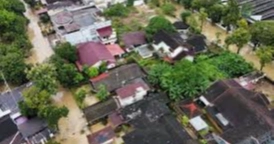
Aerial footage from the three affected provinces shows large portions of forests and terraced hillsides torn apart, sending rivers of mud into surrounding valleys. In North Sumatra, large areas of Medan and Deli Serdang regency remain submerged, with rooftops barely visible above the brown floodwaters. Roads now resemble canals filled with stranded vehicles and debris.
Rescue teams continued Friday to try to reach isolated communities where infrastructure has been destroyed. In many places, aid can only be delivered on foot due to severe terrain. Twelve cities and districts in North Sumatra are struggling with access issues, while flooding in West Sumatra has ruined rice fields, livestock, and public facilities.
In Aceh, authorities are still trying to get excavators and heavy equipment across washed-out roads after intense rain sent mud and rocks cascading into hillside villages.
Meteorologist Achadi Subarkah Raharjo said the extreme weather was fueled by Tropical Cyclone Senyar, which formed in the Strait of Malacca. He warned that unstable atmospheric conditions could prolong dangerous weather as long as the cyclone’s remnants persist. Senyar produced heavy rain, strong winds, and rough seas across Aceh, North Sumatra, West Sumatra, Riau, and nearby regions before weakening.
Indonesia regularly experiences landslides and flooding during the rainy season, particularly in its mountainous regions and fertile floodplains.