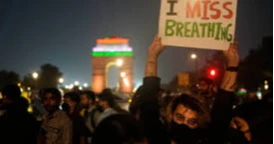
Recent remarks by Indian officials have sparked frustration among residents who say the government is downplaying the severity of air pollution in the country’s capital.
Environment Minister Bhupender Yadav recently told Parliament that New Delhi recorded 200 days of “good” air quality this year. Experts and opposition leaders criticized the figure, saying it ignored the city’s worst pollution months. Days later, Delhi Chief Minister Rekha Gupta suggested that air quality could be managed like a temperature reading by spraying water, prompting public jeers at a city event. Earlier this year, Gupta approved a controversial cloud seeding program intended to reduce pollution, despite limited evidence of its effectiveness.
Residents say such comments highlight officials’ reluctance to address the city’s toxic smog. “Instead of doing cloud seeding, I hope the government will wake up and take some real action,” said 73-year-old resident Anita.
Experts note that India’s air quality standards are less strict than those of the U.S. and the World Health Organization, and monitoring networks are too sparse to accurately capture local pollution levels. While the National Clean Air Program, launched in 2019, has funded monitors and dust-reduction measures, it has done little to curb industrial or vehicular emissions—the country’s largest pollution sources. A 2024 report found that 64% of program funds went toward dust control, only 12% to vehicle pollution, and less than 1% to industrial emissions.
The health impacts are severe. A 2024 Lancet study linked long-term exposure to polluted air in India to 1.5 million additional deaths annually compared with WHO standards. Yet officials, including junior health minister Prataprao Jadhav, have questioned the availability of conclusive data connecting pollution to disease or death.
Campaigners warn that pregnant women, children, and the elderly are particularly at risk. “Exposure at this stage has a lifelong consequence,” said Shweta Narayan of the Global Climate and Health Alliance.
Protests in New Delhi this month reflected growing public frustration. Environmentalist Vimlendu Jha criticized authorities for prioritizing image management over genuine action.
“Everyone feels the pollution. People are not able to work or even breathe,” said Satish Sharma, a 60-year-old auto-rickshaw driver, who has reduced his work hours due to deteriorating health. “I want to tell the government to please do something about this pollution. Otherwise, people will move away from here.”
Source: AP