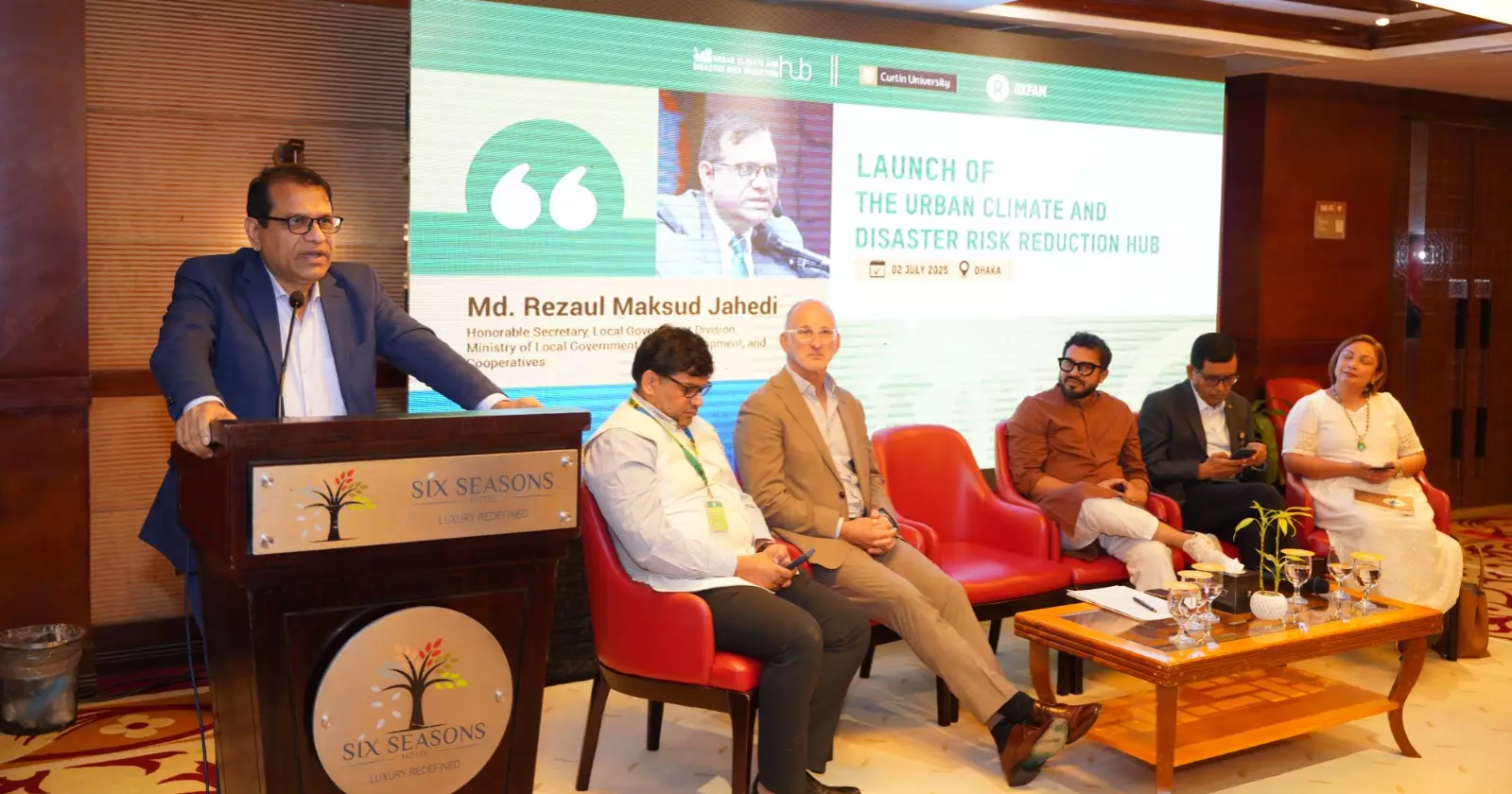
Oxfam in Bangladesh and the Curtin University of Australia on Wednesday launched the Urban Climate and Disaster Risk Reduction Hub in Dhaka with an aim to foster urban resilience with climate action and disaster response following research, innovation, collaboration and advocacy.
The Hub launched seeks to address urban climate and disaster challenges through cutting-edge research, inclusive policy advocacy, capacity-building, and community-led innovation.
At present it focuses on six core themes: urban heat and pollution, energy transitions, green infrastructure, geospatial science, climate justice, and emergency response systems.
Speaking at the launch of the Urban Climate and Disaster Risk Reduction Hub in Dhaka, Country Director of Oxfam in Bangladesh Ashish Damle said cities like Dhaka are under siege from overlapping crises—soaring heat, air pollution, unplanned growth, and frequent climate-induced disasters.
"These challenges are pushing the most vulnerable communities deeper into risk," Dample said.
Cities worldwide teeter on the edge of environmental tipping points with record-breaking temperatures, intensifying floods, and mounting social inequalities, he said.
With over 58% of the world’s population now living in urban areas—a number expected to hit 70% by 2050—cities are both victims and vectors of the climate crisis.
Bonn Climate Talks criticised by vulnerable nations; YouthNet urges urgent action ahead of COP30
They consume 75% of global energy, produce over 70% of CO₂ emissions, and are increasingly vulnerable to heatwaves, air pollution, sea-level rise, and floods with an exacerbating agent of inequalities, said a press release of Oxfam.
2024 was the hottest year on record, and urban poor and marginal communities like Dhaka's urban poor—many of whom live in informal settlements—face climate risks up to 10 times greater than their wealthier counterparts.
“Urbanization is reshaping our planet—and with it, reshaping our vulnerabilities,” said Professor Martin Van Kranendonk, Head of the School of Earth and Planetary Sciences at Curtin University.
“Urban areas face the brunt of climate change but also house the tools for transformation. The Hub bridges science and community to create locally grounded, globally scalable solutions.”
“Urban development today cannot ignore climate resilience,” stated Nayoka Martinez-Bäckström, First Secretary and Deputy Head of Development Cooperation at the Embassy of Sweden in Dhaka.
“The Hub is vital for fostering integrated planning, especially for vulnerable urban populations.”
Addressing the gathering, Md Shahjahan Mia, Administrator of Dhaka South City Corporation, underscored the urgency of collaborative action: “From flooding to heat stress, Dhaka faces the spectrum of climate risks.
Mohammad Azaz, Administrator of Dhaka North City Corporation, said: “In urban governance, the best solutions often come from the ground up. We need adaptive strategies, coordinated leadership, and community-driven designs to meet today’s urban challenges.”
Dr. Mohammad Emran Hasan, Head of Climate Justice & Natural Resource Rights at Oxfam in Bangladesh and Dr. Ashraf Dewan, Professor at Curtin University gave a detailed presentation on the context, vision, and roadmap of the Hub. Md Sariful Islam, Head of Influencing, Communications, Advocacy and Media, Oxfam in Bangladesh moderated the session.
The second half of the event featured two research presentations followed by a panel discussion. Dr. Fei Yang from the Chinese Academy of Sciences presented critical findings on urban heat stress in informal settlements, while Dr. Mo Hoque from the University of Portsmouth highlighted the role of data and technology.
Moderated by Sarder M Asaduzzaman of UNDP Bangladesh, brought together experts including Hasin Jahan (WaterAid Bangladesh), Tomas Wörlund Rylenius (Embassy of Sweden), Dr. Md. Golam Rabbani (Climate Bridge Fund, BRAC), and Mr. Mohammad Barad Hossain Chowdhury (Ministry of Education).
Bonayan to distribute 3 million saplings across the country to commemorate World Environment Day
The event drew broad participation from civil society, academia, media, development partners, and municipal authorities.
The Hub sets a precedent not only for Bangladesh but for other countries facing the triple burden of climate change, urbanization, and social inequality.