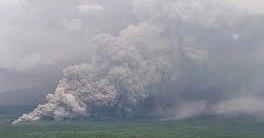
Indonesian officials reported Thursday that more than 170 climbers stranded by an unexpected eruption on Mount Semeru have been assisted back to safety, as seismic readings suggest that activity at the island of Java’s tallest volcano is likely to continue.
A total of 178 people — including hikers, porters, guides, tourism staff, and visitors — began their ascent of the 3,676-meter (12,060-foot) mountain in East Java’s Lumajang district on Wednesday but became stuck at the Ranu Kumbolo camping site.
“They are all safe and currently being escorted back,” said Priatin Hadi Wijaya, head of the Center for Volcanology and Geological Disaster Mitigation, during a video briefing.
Another official, Hetty Triastuty, noted that Ranu Kumbolo lies outside the 8-kilometer (5-mile) main hazard zone around the crater. Positioned on the volcano’s northern slope, the area is not in the path of the hot cloud flows that moved south-southeast. Still, climbers may have encountered volcanic ash.
On Wednesday, Mount Semeru released multiple surges of blistering ash clouds and a mix of rocks, lava, and gas that swept as far as 13 kilometers (8 miles) down its slopes. A thick column of ash shot 2 kilometers (1.2 miles) into the sky, prompting Indonesia’s Geology Agency chief Muhammad Wafid to raise the alert status to its highest level.
He explained that several pyroclastic flows raced down the volcano, and glowing avalanches of volcanic debris were visible moving through the Besuk Kobokan River valley on the southern side.
“Semeru’s seismic activity shows the eruption remains intense, with a rising number of signals indicating avalanches,” Wafid said.
He urged the public to avoid areas along the Besuk Kobokan River — the main route for lava and hot gas — and said authorities are considering expanding the current 8-kilometer danger radius.
Nearly 1,000 residents from three high-risk villages in Lumajang district have been moved to government shelters, according to National Disaster Mitigation Agency spokesperson Abdul Muhari. No injuries or deaths have been reported.
Social media footage captured thick ash clouds sweeping over farmland and forested valleys toward a river under a bridge.
The ongoing eruptions covered several villages in heavy ash and blocked sunlight. Local media reported the smell of sulfur in some areas and said two motorcyclists suffered severe burns after crashing on a bridge coated with hot ash.
Mount Semeru, also called Mahameru, has erupted repeatedly over the past two centuries. As with many of Indonesia’s 129 active volcanoes, large populations continue to live on its fertile slopes.
Its last major eruption in December 2021 killed 51 people and left hundreds with burns as villages were buried in mud and ash. More than 10,000 residents were evacuated, and roughly 2,970 homes were relocated out of danger zones.
Indonesia — home to over 280 million people — lies along the Pacific “Ring of Fire,” a region of active seismic faults prone to frequent earthquakes and volcanic eruptions.