
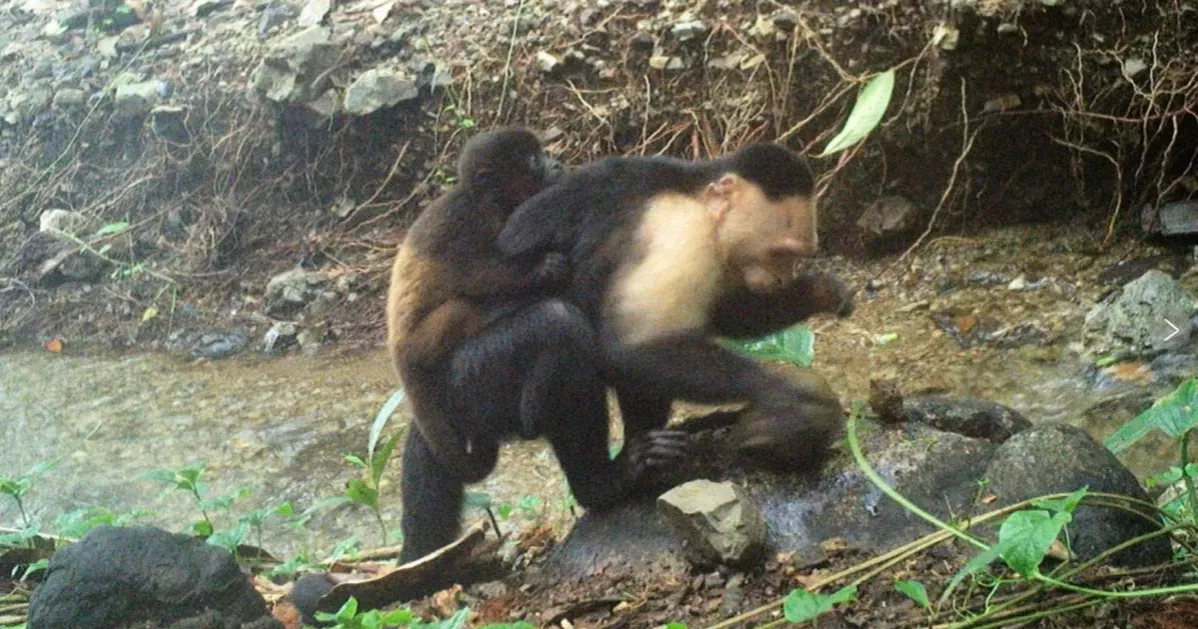
A young howler monkey was seen clinging to the back of an older male monkey, tightly gripping its fur.
But the two weren't related — and they weren’t even the same species.
Scientists reviewing camera footage from a small island in Panama discovered unexpected and unsettling behavior: capuchin monkeys were seen taking baby howler monkeys. At least 11 such incidents occurred between 2022 and 2023.
“This was an incredibly surprising discovery,” said Zoë Goldsborough, a behavioral ecologist at Germany’s Max Planck Institute of Animal Behavior. “We’ve never documented anything quite like this in the animal world.”
The reasons behind the behavior remain unclear. Capuchins, which are roughly the size of house cats, live in Central and South America. Known for their intelligence, they can adopt new behaviors socially, and one group in Panama even uses stones to crack open nuts and shellfish.
Goldsborough and her colleagues from Max Planck and the Smithsonian Tropical Research Institute had originally set up over 80 cameras to study tool use among capuchins. But in early 2022, they unexpectedly began recording young howler monkeys appearing in the footage.
The videos showed capuchins moving around and using tools while carrying baby howlers on their backs. However, the actual abductions weren’t caught on camera — likely because they took place in the treetops, where howlers typically stay.
“Our understanding is limited by what the cameras captured,” said co-author Margaret Crofoot. The findings were published this week in the journal Current Biology.
In most of the observed cases, the infant howlers died. Typically, these babies would still be nursing and remain close to their mothers. The captured infants were only a few weeks to a few months old — too young to survive on their own.
“Part of me hopes some of them managed to get back to their mothers, but we just don’t know,” Crofoot added.
Some videos showed young male capuchins still carrying the deceased howler babies, possibly starved. Although it’s not unusual in the animal kingdom — with species like gorillas and orcas sometimes carrying their dead young — the reasons behind such behavior are still not well understood.
There were no signs of violence or intent to eat the babies, ruling out predation as a motive.
“We’ve all spent countless hours trying to figure out why this is happening,” said Goldsborough.
She speculates the first capuchin involved may have been driven by a misdirected caregiving instinct, as he handled the babies gently. Afterward, four more males began imitating the behavior.
Researchers don’t believe the capuchins intentionally harmed the infants. So far, this phenomenon has only been observed in one group.
This unusual behavior highlights just how much social dynamics can differ even within the same species, noted Catherine Crockford, a primatologist at France’s CNRS Institute for Cognitive Sciences, who was not part of the study.