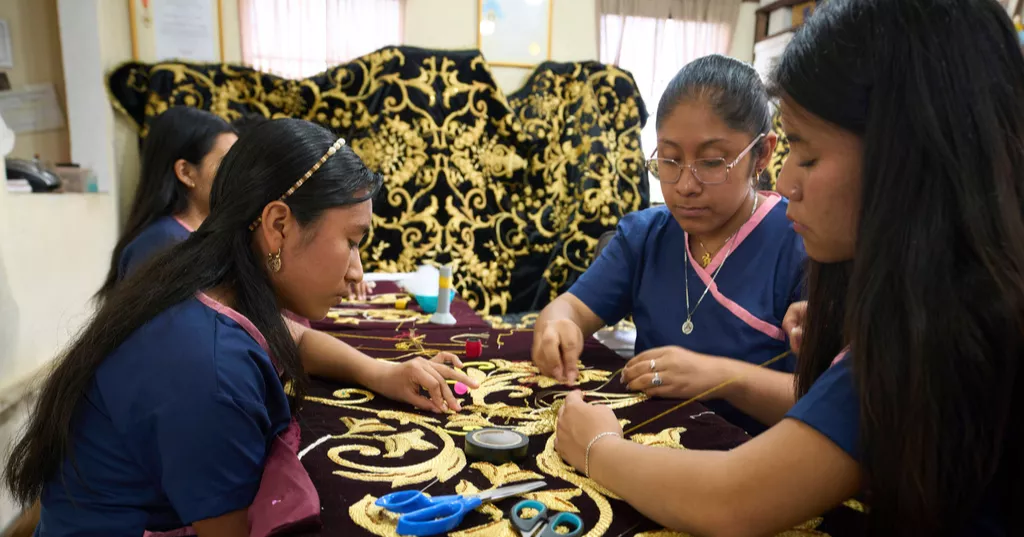
In workshops across Guatemala, artisans have spent months meticulously hand-stitching intricate garments that will be unveiled this week during Holy Week processions throughout the country and beyond.
These ornate velvet cloaks, embroidered with gold thread, will adorn wooden statues of the Virgin Mary and Jesus Christ. Carried by devotees along cobbled streets lined with thousands of spectators, the figures play a central role in the country’s Holy Week traditions.
Palm Sunday marks the Christian celebration of Jesus’ triumphant arrival in Jerusalem, where crowds welcomed him with palm branches, as described in the Bible. Holy Week, the most sacred time in the Christian calendar, also includes the Good Friday reenactment of Jesus’ crucifixion and culminates in the Easter celebration of his resurrection.
At the María Auxiliadora workshop, located about 41 kilometers southwest of Guatemala City, 28 artisans — mostly women — can be seen stitching by hand. They work with deep velvet fabrics, embroidering them with intricate gold floral patterns under the shadow of the dormant Volcano of Water.
Some cloaks, such as those made for the Virgin Mary figures, can span roughly 4 square yards (3 meters) and weigh over 50 pounds. To prevent damage to the statues, a metal structure is used to support the garments.
Workshop owner Alejandro Juárez Toledo, who has dedicated 26 years to this craft, still becomes emotional when he sees the cloaks finally draped over the figures that will be paraded through the streets.
“The most meaningful moment for me is when the embroidery is sewn onto the fabric — that’s when the emotional connection with the client begins. The whole experience becomes more fulfilling,” he said.
His team’s handmade robes have been used not only in Guatemala but also in countries such as El Salvador, Honduras, Costa Rica, and Panama.
Guatemala’s Holy Week celebrations are known for their grandeur. In 2022, UNESCO recognized them as part of the Intangible Cultural Heritage of Humanity.
Walter Gutiérrez, a history professor at San Carlos University, emphasized the importance of the events: “These processions represent the essence of Guatemala — culturally, spiritually, and traditionally.”