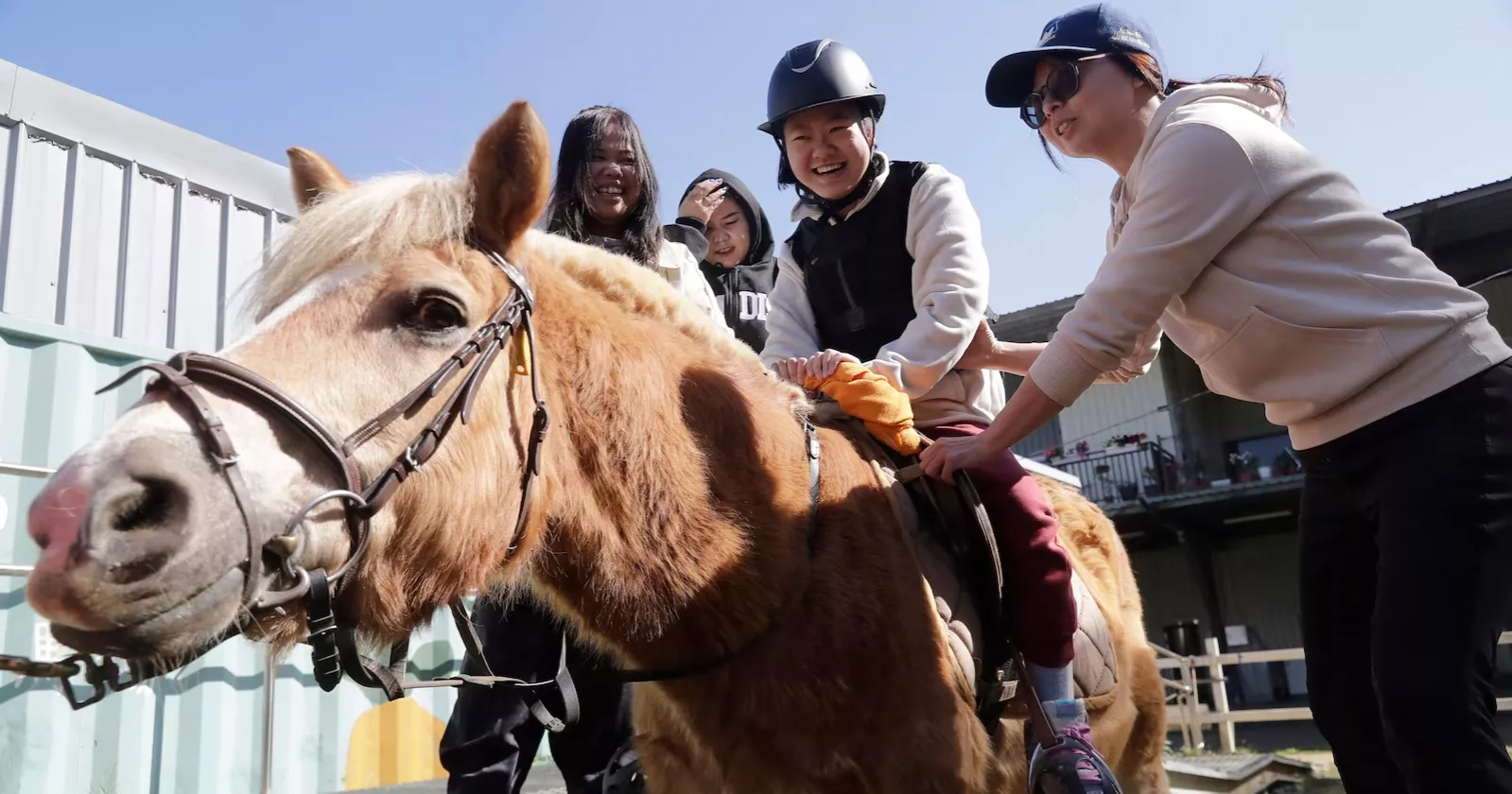
The young woman breaks into a broad smile as she gets ready to mount the horse for her weekly ride. She laughs as the animal takes its first steps.
“She was happy the first time she rode a horse,” Hector Chen said, recalling their initial visit. His daughter, Chen You-ching, was diagnosed with cerebral palsy more than 16 years ago. He has since been bringing the now 18 year old to horse therapy sessions.
At the Therapeutic Riding Center of Taiwan in Taoyuan, a city in the island’s north, children with cerebral palsy, autism, ADHD and other conditions receive companionship and therapy by riding and interacting with horses.
Animal-assisted therapy is becoming increasingly popular worldwide, whether for children with intellectual disabilities or veterans coping with trauma.
Abigail Liu said her five year old daughter has benefited greatly from the therapy. Her daughter, Ayah, has Angelman syndrome, a rare genetic disorder that causes developmental delays.
She said her daughter “has become less afraid of unfamiliar things and is more willing to try new things. All of this began after she started riding horses here.”
Read More: ‘Paush Sankranti’ horse race keeps rural tradition alive in Narail
The horses require special training to handle a child’s movements and to remain calm when surrounded by several people, said Chan Shu-ya, a horse therapist.
At times, children simply want to hug a horse for an extended period or listen to its heartbeat, and the animals will stand quietly with them.
“They feel very relaxed, because the horse doesn’t show irritation even if they keep talking to it,” said Alain Chang, a horse riding coach at the Fang Hsing-Chung Social Welfare Foundation for Horses in Education and Health. “For them to come here to touch, observe or even hug the horses is a very special experience.”
“Many of the students I work with look forward to coming here every week, rain or shine,” he said.