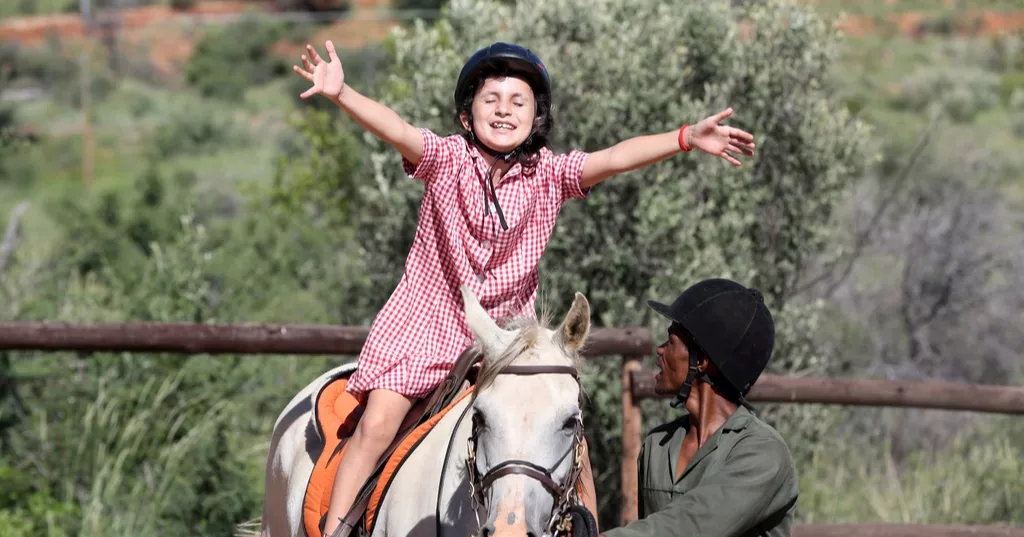
In Namibia, Susan de Meyer runs a unique therapy program using horses to support children with learning disabilities. The animals seem to have a calming influence: hyperactive children become more focused, and those who are nonverbal begin to connect and express themselves.
Her program, located just outside Windhoek, engages 8 to 10 students each weekday from special needs schools. The children ride, groom, and interact with the horses — often opening up and talking to them.
Raised on a farm, de Meyer has always had horses in her life. She believes they offer something truly special: they accept children without judgment.
“The horse is the real star here because many of these kids feel overwhelmed around too many people,” she said.
Called "Enabling Through the Horse," her initiative is backed by the Namibian Equestrian Federation and has been internationally recognized. Last year, it received an award from the International Equestrian Federation for highlighting the horse’s intuitive and sensitive nature.
Equine therapy is increasingly acknowledged for its benefits, particularly for those with autism, ADHD, and other developmental conditions. Animal-assisted therapy more broadly has proven helpful in a range of situations, such as aiding veterans with PTSD or comforting hospital and nursing home patients with therapy animals.
Even victims of the 2023 Hawaii wildfires have found comfort through horse therapy during their recovery.
De Meyer jokes that she has “two-and-a-half horses”: two full-sized Arabians — Faranah (a white mare) and Lansha (a brown gelding) — and a miniature horse named Bonzi, who is small enough to be eye-level with a kindergartener.
She says the larger horses are particularly helpful in therapy because their size boosts children's confidence. “When they pet the horse, the therapy begins. These animals are huge to them, but they’re not afraid — they ride, they give instructions, and they grow more confident.”
De Meyer works with children who face a range of challenges, including autism, ADHD, Down syndrome, nonverbal communication, sensory issues, and developmental delays due to fetal alcohol syndrome. Her work has drawn interest from countries in Africa and Asia interested in replicating the model.
Chriszell Louw, a teacher at Dagbreek School — one of only two public schools in Namibia for children with intellectual disabilities — says the program has had a visible impact. “One of our students talks constantly, but during these sessions, she sits quietly in her place,” Louw said. “Others have grown more outgoing and joyful. Some were terrified at first, but now they’re eager to come and ride.”
De Meyer explains that the program enhances physical skills like coordination, posture, balance, and muscle strength — all of which are critical for children who struggle with traditional classroom learning.
One exercise involves children letting go of the reins and stretching their arms out to the sides, balancing with their core as a handler leads the horse. Many smile broadly during this activity, looking like they’re flying.
“We’re changing the world for these kids,” de Meyer said.