
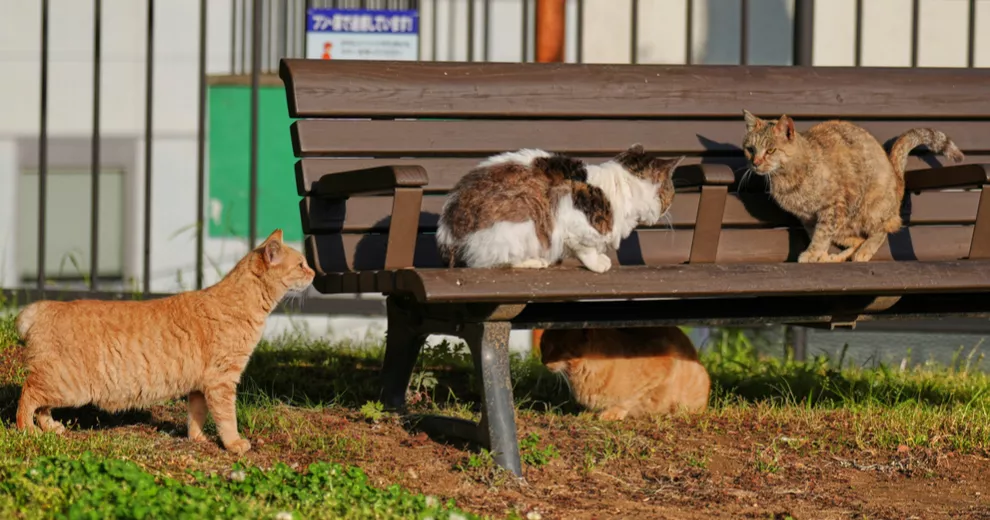
In Japan, cats with short, bent tails are believed to bring good luck, and Nagasaki is one of the best places to see them.
Known locally as “omagari neko” (bent-tail cats) or “kagi neko” (hook cats), these feline charmers have a dedicated following, complete with a special Shinto shrine and their own fan society—the Nagasaki Cat Society.
According to Kazuya Hideshima, a staff member at the Omagari Neko Shrine and a member of the society, the cats’ distinctive tails come in a variety of shapes, including hooked tips, curls, and bun-like forms.
Studies show that bobtail cats make up about 80% of Nagasaki’s feline population—double the proportion found anywhere else in Japan.
Cats are thought to have arrived in Japan from China in the 6th century, brought by Buddhist monks to protect sacred texts from rats during sea voyages. The bobtails of Nagasaki, however, trace their lineage back to the Dutch East Indies. During Japan’s period of isolation (17th–19th century), Nagasaki was the country’s only open port, and ships from Southeast Asia relied on these cats to safeguard goods from rodent damage.
Veterinarian and feline expert Soshin Yamamoto explained that the bobtail trait likely resulted from a genetic mutation that flourished in the relatively closed environment of historical Nagasaki. “Having bobtails doesn’t impact a cat’s well-being, especially if they live around humans and don’t need to navigate wild terrain,” he said.
Today, Nagasaki locals hope these lucky cats can also bring fortune in the form of tourism and economic activity.
“I already knew Nagasaki was famous for these bent-tail cats,” said Natsuno Kani, a 50-year-old tourist from Tokyo, while visiting the cat shrine.
But for others, the discovery was a surprise. “This is my first time hearing about them,” said Abigail Tarraso, a Spanish artist living in neighboring Saga prefecture. Similarly, American artist Cindy Bi, also visiting Nagasaki, said, “I’m excited to look for them—maybe we’ll spot a few.”