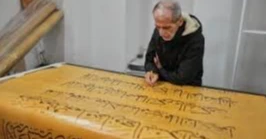
Iraqi calligrapher Ali Zaman has completed an extraordinary handwritten copy of the Holy Quran after six years of tireless work, marking the end of a deeply personal artistic journey.
Standing beside his creation at a mosque in Istanbul, the 54-year-old artist said finishing the manuscript filled him with pride and gratitude. “Whenever I think about this Quran, I feel very happy. God gave me the life and strength to complete it, and that makes me proud,” he told The Associated Press.
The manuscript is monumental in size and scope. It is made up of 302 double-sided scrolls, each about four metres (13 feet) long and 1.5 metres wide. The sheets, similar to thick parchment, were specially produced using traditional materials such as eggs, corn starch and alum.
Islamic calligraphy is one of the most respected art forms in the Muslim world. For centuries, it has been used not only to preserve the Quran but also to decorate mosques, palaces and manuscripts. In Turkey, the art flourished during the Ottoman period with strong state support, leading to the development of unique styles. Today, Istanbul remains a major centre for calligraphy, known locally as hat.
Art expert Umit Coskunsu said calligraphy became especially important in Islamic culture because of restrictions on depicting human figures. He described hat as more than just art. “It is seen as a form of worship, a way of getting closer to God,” he said.
Zaman was born in Ranya, in Iraq’s northern Kurdish region, and developed an interest in calligraphy at the age of 12. “I was drawn to it immediately. I felt I could find my soul in this art,” he recalled.
In 2017, he moved with his family to Istanbul to focus on the Quran project and improve his skills, saying calligraphy is more appreciated in Turkey than in his home country. For six years, he worked from dawn until dusk in a small room at the Mihrimah Sultan Mosque, carefully handwriting every sheet.
Although the manuscript is being described as the world’s largest handwritten Quran, it has not been officially recognised. Guinness World Records lists the largest printed Quran, produced in Mecca in 2025.
Zaman’s son, Rekar, remembers how rarely he saw his father during those years. “We mostly saw him when we brought food or when he came home to sleep,” he said. “Now, thankfully, we see him more.”
Read More: Three-flippered sea turtle Pyari released in Florida, now tracked by satellite
The scrolls are now safely stored and covered at the mosque. Zaman hopes the Quran will one day be displayed publicly in a museum or special cultural space where people can truly appreciate it.