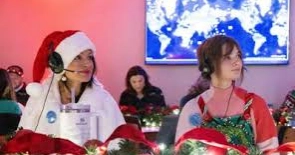
Each year, children call in with wide-ranging concerns: some hang up quickly after being reminded that Santa won’t arrive unless they’re asleep, while others worry whether he’ll be able to locate their homes.
Plenty of adults also follow Santa’s progress, staying loyal to the legendary gift-giver said to travel the globe in a single night. For seven decades, the North American Aerospace Defense Command (NORAD)—a joint U.S.-Canadian organization responsible for monitoring airspace threats—has upheld the annual tradition of tracking Santa on Christmas Eve.
This year, more than 1,000 volunteers will answer calls to the NORAD Tracks Santa hotline, 1-877-HI-NORAD, from 4 a.m. until midnight Mountain Standard Time. For the first time, callers can also connect through the program’s website, a change designed to make access easier for people outside North America.
The website allows users to follow Santa’s route in nine languages, including English and Japanese.
Last Christmas Eve, roughly 380,000 calls poured into a festively decorated hangar at Peterson Space Force Base in Colorado Springs, where NORAD is headquartered.
Although Santa poses no danger, NORAD can still track his travels using the same radar systems, satellites and fighter jets it relies on throughout the year, said Col. Kelly Frushour, a NORAD spokesperson. According to her, Rudolph’s glowing nose gives off a heat signature similar to that of a missile, which allows satellites to detect Santa’s sleigh.
“Faster than starlight”
Frushour recalled a call from last year in which a young girl became distressed after hearing Santa was headed toward the International Space Station, where two astronauts were stranded at the time.
“By the end of the call, Santa had already moved on, and she was reassured that he wasn’t stuck in space and would still visit her home later that night,” Frushour said.
Michelle Martin, a NORAD employee and Marine veteran, shared another memorable call from a man with special needs named Henry, who phones in every year. He once asked whether the jet escorting Santa could pass along a note saying he was already in bed and ready for Santa’s visit.
Martin said she explained that Santa moves “faster than starlight,” making it impossible for the pilot to catch up. “He just waves as Santa zooms by,” she recalled telling him.
A tradition born from a mistake
The tradition began in 1955, during the Cold War, when NORAD’s predecessor—the Continental Air Defense Command (CONAD)—was focused on detecting potential nuclear attacks from the Soviet Union. According to NORAD, a child accidentally dialed the operations center and asked to speak with Santa Claus. Rather than disappointing the child, the commander on duty, Air Force Col. Harry Shoup, instructed his team to track Santa and answer children’s calls.
The call may have been triggered by a misprinted or misdialed phone number in a Sears newspaper advertisement that encouraged children in Colorado Springs to call Santa.
Over time, the story evolved, suggesting the call reached a top-secret hotline reserved for emergencies. However, in 2015, The Atlantic questioned that version, noting that a public number was more likely and pointing out Shoup’s reputation for embracing publicity.
In a 1999 interview with The Associated Press, Shoup recalled going along with the situation once he realized what was happening. “Ho, ho, ho, I am Santa,” he told the first caller.
“My crew thought I’d lost my mind,” he said, adding that he soon explained the situation and asked his staff to play along.
The exact date of the first call remains uncertain, but by Dec. 23 of that year, the AP reported that CONAD was officially tracking Santa.
CONAD later became NORAD and for years operated from the fortified Cheyenne Mountain complex, where tunnels carved into solid granite were designed to protect personnel in the event of a nuclear attack.