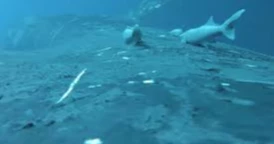
Traveling across the ocean doesn’t get much smoother — or more stylish — than catching a ride on a whale, at least if you’re a remora.
Marine researchers studying humpback whales off Australia have filmed remarkable footage of these so-called sucker fish clinging to their massive hosts, peeling away just before the whales breach, and then expertly reattaching as the animals crash back into the sea. The precision is astonishing — like synchronized swimmers or Olympic gymnasts sticking a landing.
Remoras, or Remora australis, spend nearly their entire lives attached to whales or other large sea creatures. Using a suction-like disc on their heads, they create a vacuum seal that allows them to hang on tightly while feeding on scraps of skin and parasites — a convenient arrangement for both species.
Whale Cameras Reveal Ocean Hitchhikers
The extraordinary scenes were recorded unintentionally by Olaf Meynecke, a marine scientist from Griffith University’s Whales and Climate Research Program. Meynecke had attached suction-cup cameras to humpbacks during their annual migration from Antarctica to Australia’s Queensland coast.
Instead of just whale behavior, his footage showed entire schools of remoras — sometimes 50 or more — jockeying for position on the same patch of skin where the cameras were mounted.
“Whenever the whales breached or made sudden moves, the sucker fish reacted almost instantly,” Meynecke said. “They seemed to know exactly when to let go before the whale hit the surface, and then reattached within seconds once it was back underwater.”
A Sticky but Strained Relationship
While remoras are harmless and even help whales by eating parasites, Meynecke believes some whales find their clingy companions irritating.
“In some cases, we saw whales with lots of remoras repeatedly breaching, even when no other whales were nearby,” he said. “It looked like they were trying to shake them off — almost checking afterward to see if they had fewer attached.”
The Mystery of the Journey
Each year, about 40,000 humpbacks travel along Australia’s so-called “humpback highway,” migrating between Antarctica and Queensland — a round trip of roughly 10,000 kilometers (6,000 miles). But how long their remora passengers stay aboard remains unclear.
“I suspect most remoras detach at some point in temperate waters,” Meynecke said. “But where do they go after that? Do they find other hosts until the whales return?”
When separated from whales, remoras often latch onto other large sea animals — such as manta rays, dolphins, or even scuba divers — much to the divers’ frustration.
“They’re not easy to shake off,” Meynecke joked.