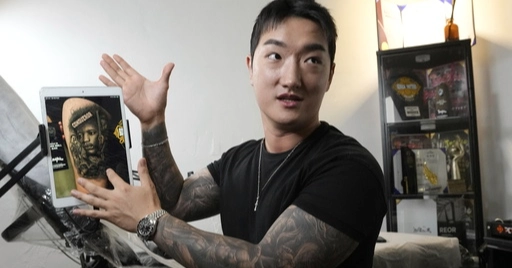
Popular tattoo artist Song Jaemin is booked weeks in advance and admired by clients from around the world. Yet each tattoo he inks is technically illegal, as South Korea only permits licensed doctors to perform the practice.
That could soon change. The National Assembly is expected to pass the Tattooist Act, a landmark bill that would allow non-medical professionals to legally give tattoos.
“I started this knowing it was illegal, but I believed the law would change one day,” said Song, 28, at his studio near Seoul. “Many tattooists feel we’re not doing anything wrong — it’s just that there’s no law for us.”
For years, tens of thousands of tattoo artists have campaigned through rallies, court appeals, and petitions to overturn the decades-old ban. Their movement has gained momentum as public attitudes toward tattoos have shifted from taboo to mainstream, with K-pop stars like BTS’s Jungkook, TWICE’s Chaeyoung, and BigBang’s G-Dragon openly sporting ink.
Experts estimate millions of South Koreans now have tattoos, with around 70% opting for semi-permanent cosmetic designs on eyebrows, eyelids, lips, or scalps. Yet, under a 1992 Supreme Court ruling, tattooing remains classified as a medical procedure, and artists face up to five years in prison or fines of 50 million won ($35,740).
Pamela Anderson embraces makeup-free look, inspires women to follow
Although enforcement is lax, many tattooists work discreetly, fearing reports to authorities or harassment. Some have gone abroad, while others run studios without signs. “I was truly terrified when someone close to me threatened to report my business,” said Kim Sho-yun, 45, who runs a cosmetic tattoo shop.
The Tattooist Act, if passed, would introduce an official licensing system and require annual hygiene training for practitioners. While some artists worry about government oversight, many say it would bring long-sought legitimacy.
The bill has bipartisan support and backing from the Health Ministry, with doctors’ opposition waning. It has cleared parliamentary committees and could pass in a plenary session as early as Thursday. A two-year grace period would follow before it takes effect.
For many tattooists, the law would bring relief. “I think I’ll cry if it passes,” said Kim. “It would lift a heavy burden off my shoulders.”
Day and night share equal time as fall equinox arrives Monday
Song, who has won national awards, said his work often carries deep meaning. Recent designs include portraits of loved ones and religious imagery. “There are no limits in tattoos,” he said. “Whatever you draw on paper or walls, we can put on the human body.”
Clients like Lee Byong-joo, 37, see tattoos as lifelong art. “I feel good having pictures I love on my body forever,” he said, while showing his new Jesus Christ tattoo. “But my wife told me this will be my last one.”
Source: Agency