
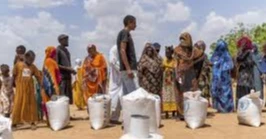
As the conflict in Sudan grinds on, millions are battling severe food shortages, forcing many to survive on wild plants and weeds. With little else available, families boil these in salted water to stave off hunger.
One retired schoolteacher, 60, expressed his gratitude through poetry, praising a plant called Khadija Koro as “a balm in times of fear” that kept him and others alive. Speaking under the condition of anonymity due to security concerns, he is one of nearly 25 million Sudanese now suffering from acute food insecurity, according to the Integrated Food Security Phase Classification (IPC).
The ongoing war, which began in April 2023 between Sudan’s military and the paramilitary Rapid Support Forces (RSF), has devastated the country. More than 20,000 people have died, nearly 13 million have been displaced, and the conflict has sparked what aid agencies are calling the world’s largest hunger emergency. Once considered a global agricultural hub, Sudan now struggles with surging food prices, diminished farmland, and obstructed aid routes.
Regions such as Darfur, Kordofan, and the Nuba Mountains are particularly affected, with access severely restricted for aid organizations like the Norwegian Refugee Council. In areas like North Darfur, some residents have reportedly resorted to chewing on coal to quell hunger pains.
On Friday, UN Secretary-General António Guterres urged Sudanese military leader Gen. Abdel-Fattah Burhan to agree to a week-long ceasefire in El Fasher to allow humanitarian access. While Burhan consented, it remains unclear if the RSF will reciprocate.
The retired teacher said that although occasional aid offers brief relief, it is insufficient. His wife and children, living in Obeid, also face high food costs and limited availability. Due to blocked roads and security risks, he is unable to travel to join them. His irregular income from training jobs barely covers essential needs, allowing him to send only around $35 a week to support his family.
In other conflict-affected regions, such as South Kordofan, residents say living conditions are dire. Hassan, a resident of Kadugli, described the area as a “prison for civilians,” citing the collapse of food distribution, health care, and basic services due to the RSF siege. He also spoke on condition of anonymity due to safety concerns.
Local and international humanitarian groups have reportedly been banned in some conflict zones. With access to food, water, and medicine cut off, desperate civilians are turning to wild vegetation for survival.
World Food Programme spokesperson Leni Kinzli confirmed that parts of Khartoum, Gezeira, and much of Darfur are at risk of famine. The WFP assists over 4 million people monthly, with 1.7 million in areas classified as high risk.
Despite government claims that famine is not present, the situation remains bleak. Ongoing fighting between government forces, RSF, and the Sudan People’s Liberation Movement-North (SPLM-N) has made it nearly impossible for aid to reach many regions.
In South Darfur’s Nyala region, civilians are attempting to grow crops, but violence and resource shortages hinder agriculture. Displaced resident Hawaa Hussein said she and her family of eight receive food parcels every two months but often rely on community support to meet their needs. "It’s hard to eat when your neighbor is starving," she said.
At El Serif camp, where nearly 49,000 displaced people now live, only about 5% of food needs are being met, according to camp leader Abdalrahman Idris. More than 5,000 new arrivals have come since the war began, many fleeing violence in the capital.
Further north, in Zamzam camp near El Fasher, famine and violence have created catastrophic conditions. An aid worker, who fled the camp recently, reported that basic goods are unaffordable — sugar sells for 20,000 Sudanese pounds (roughly $33), and soap for 10,000 pounds (about $17). Several vulnerable residents, including the elderly and pregnant women, have reportedly died due to hunger and the lack of medical care.
Describing the camp as “a place where people wait to die,” the aid worker said the humanitarian situation continues to worsen.
Still, the retired teacher clings to hope, ending his poem with these lines:
“When people clashed and death filled the city squares, you, Koro, were a symbol of life and a title of loyalty.”