
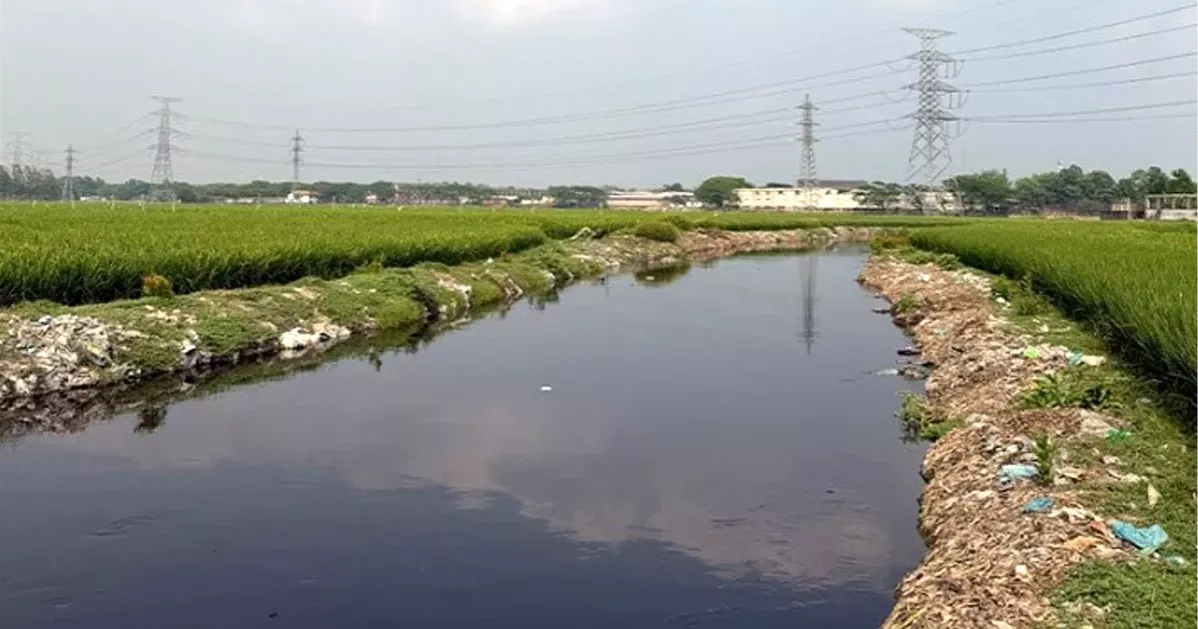
There was a time when sailboats swayed on its crystal-clear waters, and the songs of boatmen painted a timeless picture of rural Bengal. Today, the Labandaha river of Gazipur stands among the most endangered rivers in the country — like a wounded body, barely breathing. In the iron grip of encroachment and pollution, this river is losing its glory. Only its memory remains, alongside a suffocating shell of what it once was. The death of Labandaha is not merely the story of one river; it is a long tale of neglect, greed, and indifference.
Choked by plastic waste, industrial effluents, and municipal garbage, it ranks among the most polluted rivers in the country. In fact, calling it a river at this point is generous — "canal" or "drain" would be more accurate. Experts say that the burden of unplanned development across the country is falling squarely on its rivers. Tragically, waterways are now considered the ideal dumping ground for waste from virtually every sector. And since rivers are now recognised as living entities, their deaths will ultimately be measured in terms of the human lives they endanger.
Climate Change and Health Impacts – An Economic Case for Investment in Bangladesh
A Research Warning
A recent study covering 56 major rivers found Gazipur's Labandaha among the three most polluted. Conducted by the River and Delta Research Centre (RDRC) in 2022–23, the study measured water quality across these rivers and found that plastic and industrial pollution has spread not only to urban and semi-urban rivers, but even to those in remote areas. For Labandaha, all four water quality indicators necessary to sustain aquatic life and biodiversity are now at alarming levels.
Under the Environment Conservation Policy 1997, the ideal pH level of river water should fall between 6 and 9. Labandaha's pH stands at just 5. The Chemical Oxygen Demand (COD) should be 200 mg per litre, but here it is recorded at 46 mg/L. Dissolved Oxygen (DO), which should range between 4.5 and 8 mg/L, has collapsed to just 0.21 mg/L. Biological Oxygen Demand (BOD), with a standard of 50 mg/L, registers at 34.2 mg/L. These figures tell the story of a river on the brink of total collapse.
A River That Was Once a Sea
Local lore has it that Labandaha was once so vast it was called the "Lablong Sagar" the Lablong Sea. The river originates at the confluence of the Kshiru river in Bhaluka Upazila of Mymensingh district, flows through Sreepur Upazila in Gazipur, and eventually merges with the Turag river near Mirzapur. But who devoured this once-mighty river? How did it shrink into a tiny drain? Today it functions as little more than an open sewer.
Research shows that while plastic pollution is a common ailment, it is primarily factory effluents and municipal waste that have finished off Labandaha. A look at the industrial concentration around the river makes the cause clear.
The RDRC study identified 250 factories along its banks, every one of them discharging chemical waste directly into the river alongside all the municipal waste from Sreepur town. Pollution extends across roughly 30 kilometres through the Sreepur section alone. Around the Gazipur stretch, 39 industrial units have been established, all with waste pipelines connected directly to the river. On top of this, 15 municipal sewage lines and 11 dumping stations drain into it.
According to the NGO Nodi Paribrajak (River Wanderers), when both registered and unregistered factories are counted, approximately 2,000 factories surround the Labandaha river. The result: an once-mighty river has been encroached upon and filled in until it is now little more than a canal or a drain, stripped even of the conditions necessary for fish and aquatic life to survive.
The Spreading Damage
The impact of Labandaha's pollution has rippled outward into surrounding farmland and, ultimately, into the Turag river at its end. Chemical contamination from factory waste has rendered thousands of bighas of agricultural land in the surrounding area incapable of producing crops.
Saif Chowdhury, President of the Nodi Paribrajak group's Sreepur chapter, explains: "Labandaha is responsible for 70 to 75 percent of the pollution in the Turag river. From Maona Uttarpara to Gargoria Masterbari alone, thousands of bighas of farmland have been abandoned. These fields have become wastelands where they receive factory waste, medical waste, municipal waste, and domestic waste alike."
He further adds: "There are poultry feed factories, pharmaceutical factories, metal factories, and garment dyeing units between one and a half to two thousand factories in total. As a result, heavy metals including chromium, manganese, and lead are mixing into the water and soil here. The farmland is finished. Serious diseases are even spreading among the local population."
According to the Department of Inspection for Factories and Establishments, Sreepur Upazila alone has 438 active industrial units, with 73 of them concentrated in Maona Union. The Gazipur District Agriculture Extension Department reports that factory waste has already damaged 380 hectares of farmland across the district.
The fear is real: Gazipur, once fertile, may soon be entirely stripped of its agricultural capacity. An unplanned industrial zone is killing a river; crop production faces an existential threat; and human lives hang in the balance. Environmentalists argue that proper waste management from factories and municipalities could have prevented all of this.
The Law and the Way to Save Labandaha
The country's Supreme Court has declared Bangladesh's rivers to be "living entities" juristic or legal persons granting them fundamental rights similar to those of human beings. Yet neither factory owners, nor encroachers, nor even municipal authorities seem to pay any heed to this. Environmental lawyers point out that killing a river amounts to killing a living being. A river may be a living entity in the eyes of the law but it cannot walk into a courtroom to plead its own case against pollution or its own slow death. Someone must stand on the river's behalf. But that "someone" is rarely found. And in most cases, that someone likely lacks the power to stand against such influential forces. And so the river dies, its stench forcing a threat upon the lives of the people around it.
The path to saving Labandaha and all other at-risk rivers follows a similar route. River experts say that the monsoon season is the greatest natural blessing for river restoration. But to make use of the monsoon, all forms of waste from factories and every other source must first be managed properly within regulations. Then, before the rains arrive, the river must be dredged. If these steps are taken, even a near-dead river can be brought back to life by the monsoon. Public awareness must also be raised alongside these efforts. Researchers say that development planning must be built on the understanding that rivers are public assets and that protecting them is essential to human survival. There is absolutely no justification for killing rivers in the name of unplanned development or job creation.
Experts believe that if we do not want the list of polluted rivers to grow any longer, planned development, enforcement of the law, coordinated projects, and collective public awareness are all urgently needed. Rivers cannot be saved by budgets and projects alone; what they need is genuine liberation. And in this struggle for liberation, let a river-loving, youthful Bangladesh rise and roar. Only then will the rivers be saved and when the rivers are saved, the country will be saved. And the lives of the people will become easier.