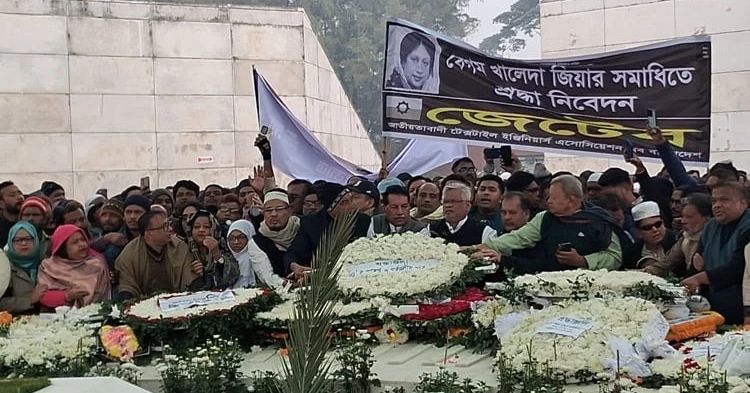
Leaders of the All-Party Students’ Unity of the 1990s, led by its then convener and former DUCSU Vice President Amanullah Aman, on Friday paid tribute to BNP Chairperson and former Prime Minister Begum Khaleda Zia.
They visited her grave around 11:40am at Zia Udyan in Sher-e-Bangla Nagar where they offered fateha and placed a wreath.
Those present included leaders of the All-Party Students’ Unity of the 1990s, such as Habibur Rahman Habib, Zahir Uddin Swapan, Khairul Kabir Khokon, Nazim Uddin Alam, Khandaker Lutfur Rahman, Nazmul Haque Pradhan and Mir Sarafat Ali Sapu, among others.
After offering prayers, Amanullah Aman told reporters that the leaders of the 1990 All-Party Students’ Unity came to honour “the uncompromising leader and leader of the nation” Begum Khaleda Zia.
“We have placed a wreath at her grave and offered fateha, praying to Allah for the salvation of her soul,” he said.
Aman said Khaleda Zia’s role and sincerity in the anti-autocracy movement of the 1990s could not be expressed in words.
“For the last 16 years, Sheikh Hasina’s fascist government filed false cases against her, sent her to jail through mock trials, subjected her to torture in prison and denied her minimum medical treatment,” he alleged.
The BNP leader also claimed that attempts were made to kill Khaleda Zia through slow poisoning, saying the Awami League and Sheikh Hasina will never be able to evade responsibility for her suffering and would have to answer for it.
Aman said the massive turnout at Khaleda Zia’s namaz-e-janaza proved her place in the nation’s history.
“The presence of a crore of people at her janaza proved that Begum Khaleda Zia was a symbol of unity, a symbol of democracy, and a vigilant guardian of the country’s independence and sovereignty. She was truly the ‘Mother of Democracy’,” he said.
The BNP recalled Khaleda Zia’s words that her only address was Bangladesh and that she would never leave the country, saying her love for the nation was unmatched.
Referring to BNP Acting Chairman Tarique Rahman, Aman said he faced severe repression and was forced into exile, but his recent return to the country created an unprecedented public response.
“The spontaneous way people welcomed him shows the deep bond between the people and the leadership of Ziaur Rahman and Begum Khaleda Zia,” he said.
Meanwhile, BNP leaders and activists continued to visit Khaleda Zia’s grave in groups throughout the day, offering prayers, placing wreaths and reciting verses from the Holy Quran.
Following Khaleda Zia’s death, BNP began observing a seven-day mourning programme. As part of it, party offices across the country kept party flags at half-mast and hoisted black flags.
Begum Khaleda Zia passed away at Evercare Hospital in Dhaka around 6:00am on December 30 while receiving treatment in the ICU. Her condition remained critical for several weeks.
Her namaz-e-janaza took place at Manik Mia Avenue on December 31, led by Baitul Mukarram National Mosque Khatib Mufti Abdul Malek, with people from all walks of life joining the prayers.
She was later buried beside her husband, Shaheed President and BNP founder Ziaur Rahman, at Zia Udyan in Sher-e-Bangla Nagar with full state honours.