
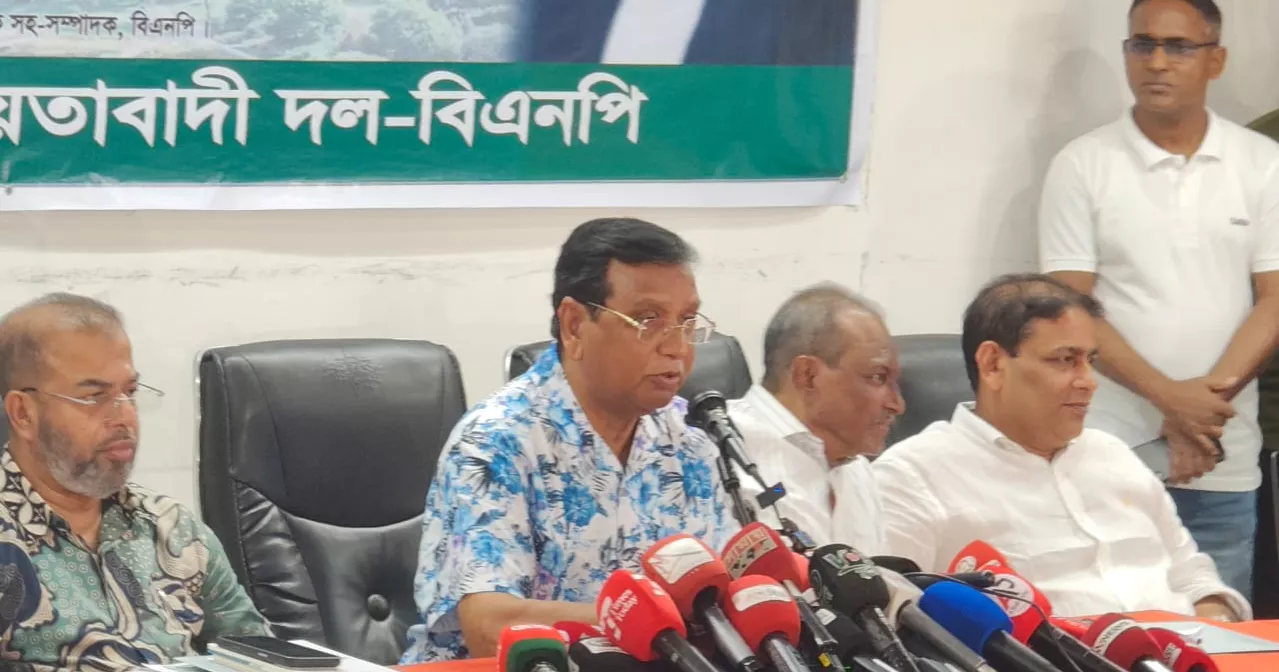
Dhaka South City Corporation (DSCC) Administrator Bir Muktijoddha Abdus Salam on Saturday alleged that a former adviser to the interim government had pushed Dhaka city “18 years backwards in 18 months.”
“One of the loudest voices on environmental issues in Bangladesh was an adviser in the last interim government. But he ruined the environment and pushed Dhaka city back by 18 years in just 18 months,” he said.
He made the remarks while addressing a discussion titled “Integrated Environmental Management: Forests, Environment, Rivers and Urbanisation,” organised by BNP at the Abdus Salam Hall of the Jaitya Press Club in the capital.
State Minister for Forests, Environment and Climate Affairs Sheikh Faridul Islam attended the programme as a special guest.
Speaking as the chief guest, Abdus Salam said implementation of environmental and urban management plans is far more difficult than making statements.
“Talking is easy, implementation is difficult. But our leader, the honourable Prime Minister, does not consider anything difficult. He tries to implement everything practically and has already taken many initiatives,” he said.
He blamed the interim government for worsening traffic congestion and the uncontrolled expansion of street hawkers in the capital.
“Today’s traffic jams and the severe hawker congestion are creations of their tenure,” he said.
The DSCC administrator stressed the need to act based on expert opinions to protect Bangladesh from future environmental disasters.
“If we fail to take measures based on expert recommendations, tougher times are waiting ahead for us,” he warned.
He also urged all political parties and citizens to unite on environmental and urban management issues.
Speaking about pollution in Dhaka, Salam acknowledged that city corporations bear responsibility but said ordinary citizens are also accountable.
“If citizens were more aware of their responsibilities, many of these problems could have been reduced,” he said.
Highlighting the looming dengue and chikungunya risks ahead of the monsoon, Salam said Prime Minister Tarique Rahman had repeatedly instructed authorities to take preventive measures in advance.
He said DSCC has launched a 15-day survey programme to identify mosquito breeding hotspots across the city.
Describing a recent inspection, Salam said he personally found mosquito larvae growing in stagnant rainwater inside broken television casings and utensils at a veterinary hospital compound near Nagar Bhaban.
“I told the hospital director that if the larvae remain there for two more days, they will turn into mosquitoes and spread dengue. Later, people will blame the city corporation for not spraying medicine, while they themselves are maintaining mosquito factories inside their homes,” he said.
He stressed that public awareness is the key to transforming Dhaka.
“If people are not made aware, then not even in 25 years will change be possible,” he said, adding that he believes Dhaka’s appearance can be transformed within two years if citizens cooperate.
He criticised Dhaka’s unplanned urbanisation, saying the city was originally designed for only a few lakh residents during the Pakistan era but now accommodates nearly two crore people.
“Residential areas like Wari, Basabo and Dhanmondi have all turned commercial,” he said.
He also blamed land grabbers and road transport mafias for damaging waterways and rail connectivity, increasing pressure on roads and worsening environmental conditions.
“If we could reduce pressure on roads by improving river and rail transport, the environmental situation would improve significantly,” he said.
Salam said public participation is essential to keeping Dhaka clean and liveable.
“Fifty percent responsibility belongs to the city corporation and the other 50 percent belongs to citizens,” he said.
BNP’s Environment and Forest Affairs Secretary Mohammad Mosaddek Hossain Bulbul chaired the programme.
Professor Dr Mahmudul Islam presented the keynote paper.
Researchers, urban planners and experts related to environment and forestry also attended the event.