BNP Standing Committee member Salahuddin Ahmed on Sunday described the recent arson attacks on two leading newspapers as a shame for the nation, questioning the government’s role over the incidents.
“The unfortunate incidents that occurred a few days ago, where several leading newspapers in Bangladesh — including The Daily Star and Prothom Alo — were burned and set on fire, have been witnessed by the whole world,” he said.
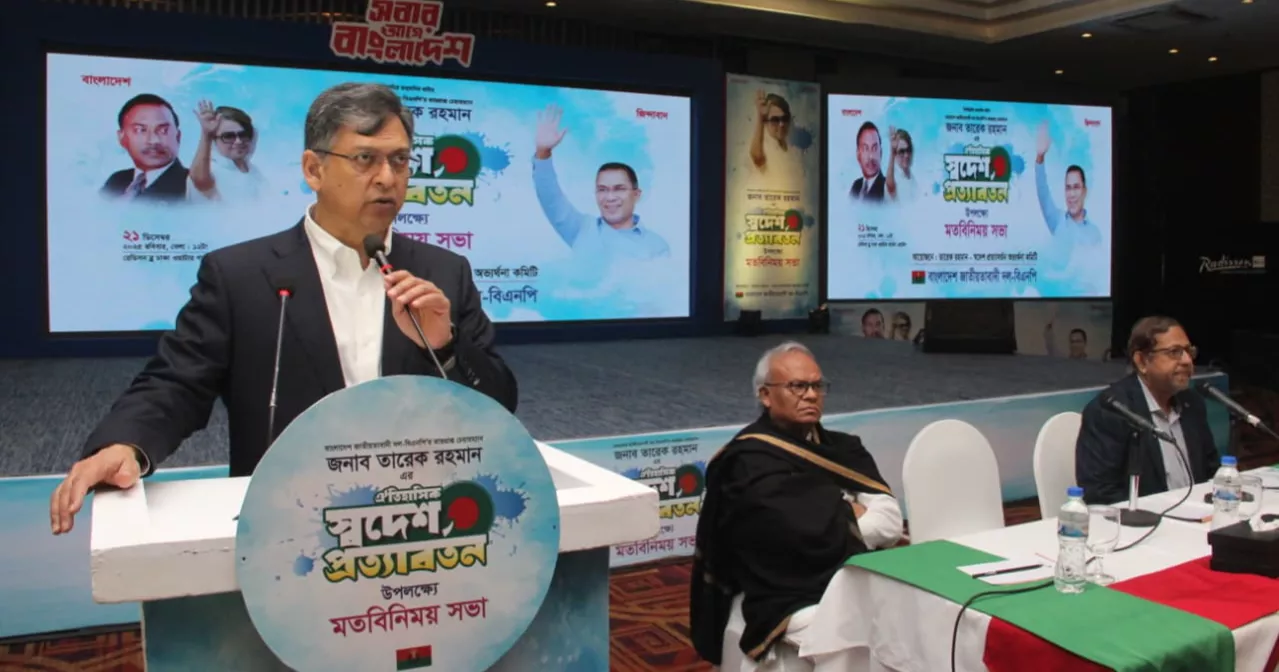
Speaking at a views-exchange meeting with editors and senior journalists at a city hotel ahead of BNP Acting Chairman Tarique Rahman’s homecoming, Salahuddin said, “As a nation, this is a matter of shame for us. We cannot simply end it with an apology and an expression of regret."
The BNP leader said newspapers and the media reflect the conscience and opinion of a nation, shaping public thought and holding power to account.
“That mirror has now been shattered,” he said, adding that journalists must not be allowed to lose that vital pride of being that mirror.
Salahuddin, a , alleged that the government failed to act despite intelligence warnings following Hadi’s death that such attacks might take place.
“There should have been predictions, intelligence reports and preparations to prevent it. We also came to know about those reports. But why was that report not taken into account?” he asked.
The BNP leader said they heard that after informing the law-enforcement agencies, the response came one to two hours later. “The role of those who are responsible for running the state and for holding a neutral election — their role in this matter is now questionable.”
He also said targeted attacks on the media were not new, and several outlets had faced similar pressure in recent months.
“It should have been predicted and assumed. The way mobocracy has been allowed at certain establishments shows that though we wanted democracy, somehow it has turned into mobocracy,” Salahuddin said.
He questioned why such a culture was allowed to grow. “I am pointing to the weakness of the government. Such mobocracy must be suppressed more strictly.”
After the mass uprising, Salahuddin said that the public’s expectations for the country are very high. “Everyone in Bangladesh wants full democracy, and democracy must be established in all institutions. To achieve this, these institutions need to be strong. Constitutional institutions must be set up to act as guardians of democracy.”
He said that many people consider the media the Fourth Estate. “If the people give BNP the responsibility of running the country, our party will fully cooperate with the media. We want to move on from past mistakes, but we must remember what fascist forces have done.”
Referring to Tarique Rahman’s return to Bangladesh, Salahuddin said the public hopes it will strengthen democracy in the country. “We want to use his return to strengthen democracy. We are not trying to empower any individual.”
He also said BNP will not support autocracy, whether personal or party-based.
The BNP leader emphasised that while the media can provide constructive criticism and understanding, it is vital to prioritise national unity and the country’s interest.
He warned about the rise of harmful forces, especially after 5 August, and said that both print and electronic media play a crucial role in keeping the nation informed and united.
The meeting was attended by editors, senior journalists, media personalities, and senior BNP leaders.