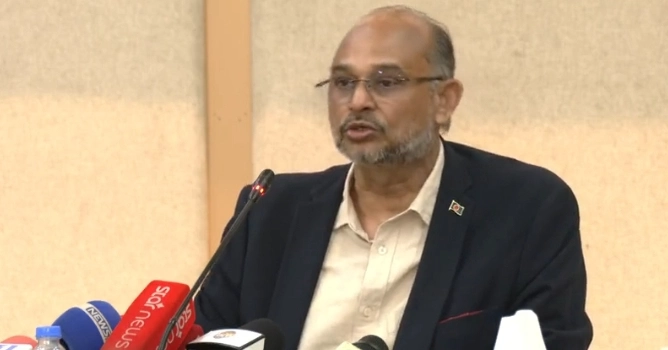
Prime Minister's Adviser on Finance and Planning Rashed Al Mahmud Titumir on Wednesday said the BNP government has a proven political history of navigating global crises while simultaneously delivering two percent economic growth, asserting that the current government is equally equipped to manage challenges arising from the ongoing Middle East conflict.
Titumir made these remarks after the inaugural meeting of the Advisory Committee formed under the Planning Commission's General Economics Division tasked with formulating economic strategies to accelerate national development and implement the government's electoral manifesto.
“Every time BNP came to power, it faced a crisis and every time, it overcame that crisis and opened new horizons,” Titumir said.
“In the 1970s, President Ziaur Rahman confronted the twin challenges of a global energy crisis and a post-famine economy. He rose to the occasion, laid the foundation of remittance earnings by exporting manpower to the Middle East, and unlocked a new chapter for Bangladesh's economy. In the 1990s, Prime Minister Khaleda Zia spearheaded a revolution in the garment industry. The two pillars of Bangladesh's economy were both built under BNP governance.”
He added that even when economists in the 1970s declared the crisis unmanageable, BNP found a way through. “BNP has always had the capacity to mobilise people and manage crises, backed by strong public support. That capacity remains intact today.”
Titumir said by objective economic indicators, Bangladesh's growth trajectory has remained essentially stagnant since BNP last left office.
“Neutral statistics show that Bangladesh's economic position did not meaningfully advance after BNP's departure. Whenever BNP has taken power, the growth rate has risen by two percentage points.”
The adviser stressed that the current government would pursue only realistic and future-oriented economic projects, rejecting schemes that are impractical.
“We will not write feel-good narratives. Development will not be confined to rhetoric. The government has begun the task of recovering a damaged economy and moving it forward.”
On social protection, Titumir said the previous system was politically motivated, often benefiting party loyalists and those who needed no assistance. “BNP has brought about a social revolution here, ensuring that benefits reach those who truly deserve them. Farmers are getting their fair dues. Women are receiving dignity through the Family Card. This is proof that Bangladesh is steadily moving towards a welfare state.”
Responding to questions on fuel prices, Titumir said the government would adjust energy prices in line with global fluctuations but would not rush into any hasty decisions. “We will calibrate price adjustments carefully to ensure inflation does not spike and farmers are not hurt during the Boro season.”
He also noted that at least 9 million people had fallen into poverty over the past three years, partly as a result of repeated hikes in gas and electricity prices by the previous government under various pretexts decisions that disproportionately burdened general people.
“The current BNP government is accountable to people and every decision will be taken with the people's welfare in mind,” the adviser said, adding that the government would craft strategic policies for energy conservation and build domestic capacity to ensure long-term energy security.