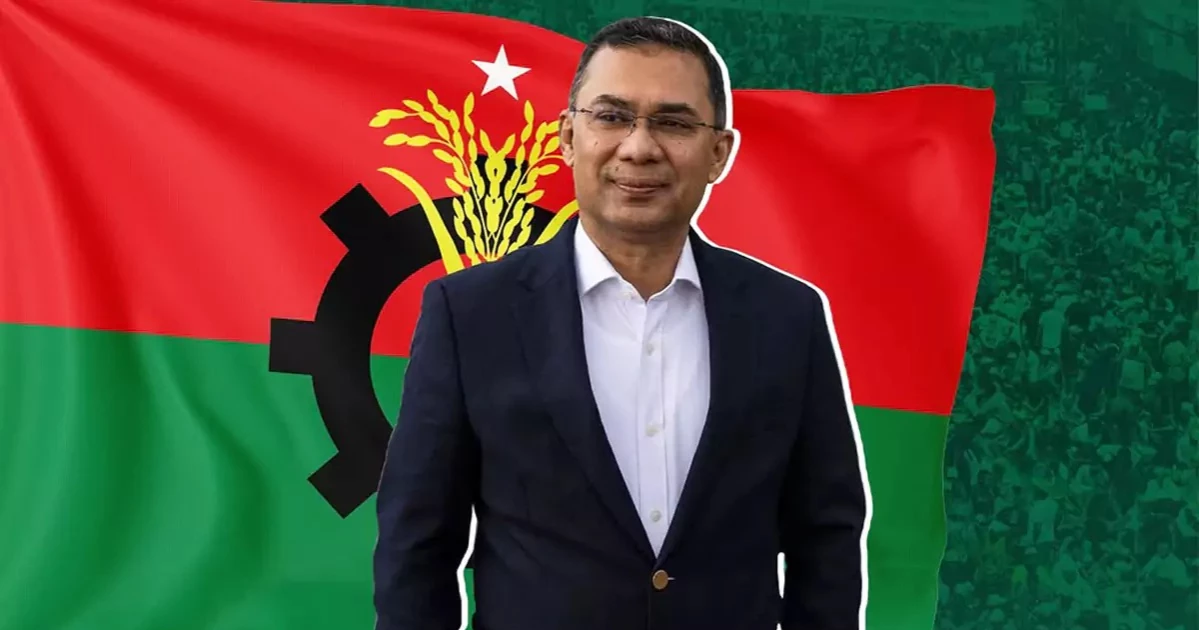
The BNP-led new government officially began its journey on Tuesday under the leadership of party Chairman Tarique Rahman, marking the BNP’s return to power after nearly two decades following a landslide victory in the 13th national election.
Among the 50-member cabinet, Tarique Rahman was sworn in as Prime Minister, followed by the ministers and state ministers, at a ceremony held at the South Plaza of the National Parliament complex in the afternoon.
President Mohammed Shahabuddin administered the oath.
Tarique Rahman: From London exile to Bangladesh’s Prime Minister
With this, Tarique became Bangladesh’s 11th Prime Minister in the country’s renewed democratic journey after the 2024 uprising, while the BNP assumed state power again after over 19 years.
Breaking with long-standing tradition, the oath-taking ceremony was held at the parliament complex instead of Bangabhaban. The programme began with the national anthem, followed by recitation from the Holy Quran.
In last Thursday’s national election, the BNP won 209 seats, while its alliance partners secured three more. Nearly 150 of the winning candidates were elected to parliament for the first time.
Leaders and representatives from several countries attended the ceremony, alongside outgoing interim government Chief Adviser Prof Muhammad Yunus, members of the advisory council, the Chief Justice, Election Commission officials, senior political leaders, chiefs of the three services, diplomats, journalists, and high-ranking civil and military officials.
Diplomatic sources said leaders from 13 countries, including China, India, Pakistan, Saudi Arabia, Turkey, the United Arab Emirates, Qatar, Malaysia, Brunei, Sri Lanka, Nepal, the Maldives, and Bhutan—were invited to attend the ceremony. Among the guests, India’s Lok Sabha Speaker Om Birla represented New Delhi.
Tarique Rahman arrived at the venue at 3:58 pm with his wife Dr Zubaida Rahman and daughter Barrister Zaima Rahman, receiving a standing ovation from the audience. President Mohammed Shahabuddin came to the venue a few minutes later, and the formal proceedings began.
The President first administered the oath and secrecy pledge to Tarique as the Prime Minister of the new government.
Tarique Rahman sworn in as Prime Minister
After congratulating the new Prime Minister, the names of cabinet members were announced. The President then administered the oath and secrecy pledge to the ministers, followed by the state ministers, concluding the ceremony.
Cabinet Composition
Apart from Tarique, the new government includes 25 ministers and 24 state ministers, with a strong presence of new faces.
Among the ministers, 16 are serving for the first time, including the Prime Minister himself, who had never previously been a minister, state minister, or MP. Nine ministers have prior cabinet experience from previous BNP governments led by Khaleda Zia.
In contrast, all 24 state ministers are first-time office holders. Overall, 41 members of the government have never served in ministerial roles before, reflecting Tarique Rahman’s plan to combine new leadership with experienced figures.
Several senior BNP leaders, including standing committee members Khandaker Mosharraf Hossain, Gayeshwar Chandra Roy, Dr Abdul Moyeen Khan, and Selima Rahman, were not included in the cabinet.
BPP elects Tarique as Leader of the House
However, Mirza Abbas, Nazrul Islam Khan, Ruhul Kabir Rizvi, Ismail Zabiullah, and Dr Rashed Al Mahmud Titumir have been appointed advisers to the Prime Minister with the status of ministers.
Besides them, Humayun Kabir, Brig Gen (retd) Shamsul Islam, Dr Zahedur Rahman, Dr Mahdi Amin, and Rehan Asif Asad have been appointed as advisers with the status of state ministers.
A major surprise in Tarique Rahman’s cabinet is Khalilur Rahman, who previously served as the interim government’s National Security Adviser and High Representative on the Rohingya issue. Though not an MP, he will serve as a technocrat Foreign Minister.
Another technocrat minister is Mohammad Aminur Rashid Yasin, former general secretary of Comilla BNP, who will also take office. Former footballer and BNP sports secretary Aminul Haque has been appointed technocrat State Minister for Sports. Both are first-time ministers, bringing expertise and fresh faces to the cabinet.
The formation of the new government follows the BNP’s decisive electoral victory and signals a major political shift after two decades.
Tarique Rahman appears to be prioritising generational change, administrative renewal, and broader political inclusion through a cabinet dominated by newcomers but supported by experienced politicians.
The 13th parliamentary election was held on February 12. Out of 300 seats in the 13th Jatiya Sangsad, the results of two seats have been suspended, while election in one seat was cancelled following the death of a candidate.
After winning the election, Tarique Rahman also met the chiefs of three opposition parties—including Jamaat-e-Islami, NCP, and Islami Andolon Bangladesh, sending out a message of positive politics.
During the meetings, he also sought cooperation from the opposition parties in governing the country.