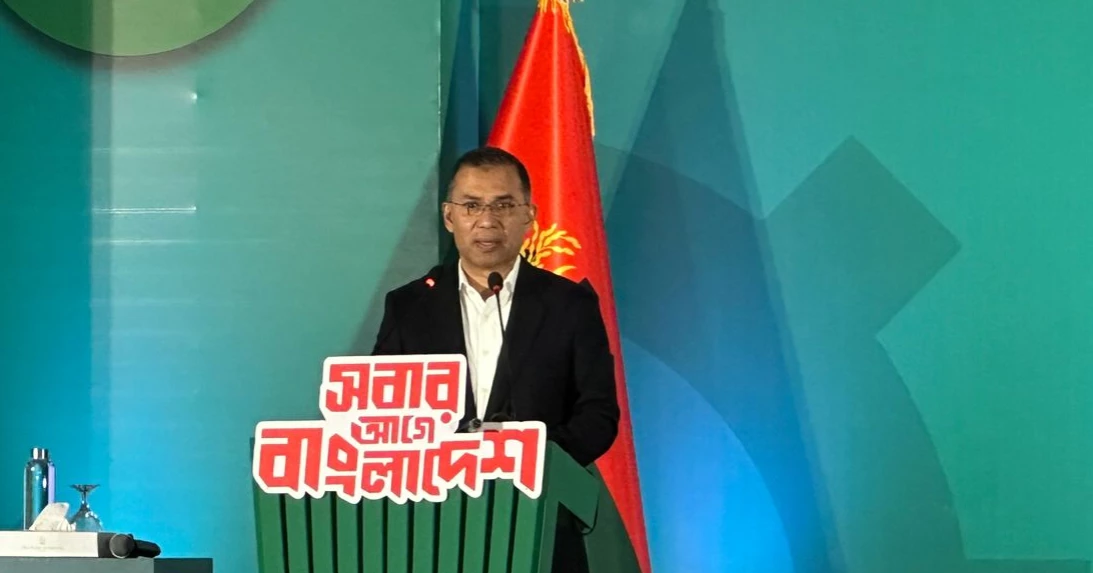
BNP on Friday rolled out its manifesto for the 13th parliamentary election under the guiding vision of 'Bangladesh First', pledging wide-ranging political, economic and social reforms to build a welfare-oriented, democratic and prosperous country.
The 44-page manifesto, announced by BNP Chairman Tarique Rahman at a formal ceremony at a city hotel in the afternoon, sets out 51 commitments under five broad sections, with nine priority pledges highlighted as the party’s immediate focus, if voted to power.
Presenting the manifesto for nearly two hours, just six days ahead of the national election, Tarique Rahman said BNP’s plans would centre on restoring good governance by giving the highest priority to ending corruption, ensuring the rule of law and establishing accountability.
“None of the plans and programmes we have placed before the nation can succeed unless corruption is eliminated, the rule of law is enforced and accountability is ensured,” he said, adding that if BNP forms the government it will act firmly on these three issues “at any cost”.
With the slogan of building a 'welfare-oriented and prosperous Bangladesh', the manifesto identifies nine priority areas, which the party said are not merely election pledges but a declaration of a new social and state contract.
The nine priorities include the introduction of a ‘Family Card’ to protect marginalised and low-income households, a ‘Farmer Card’ to ensure fair prices for agricultural produce, recruitment of 100,000 health workers, and the formulation of a skills- and values-based education policy aimed at creating a joyful and employment-oriented education system.
Other priorities focus on creating jobs for young people, developing sports as a viable profession by expanding sports infrastructure and training facilities at district and upazila levels, strengthening environmental protection and climate resilience through public participation, excavation and re-excavation of 20,000 kilometres of rivers and canals, plantation of 250 million trees in five years, and the introduction of a modern waste management system.
Beyond the nine priorities, the manifesto outlines broader commitments, including the appointment of an ombudsman, recovery of laundered money, trial of crimes against humanity committed during what BNP described as the 'fascist era', and ensuring discrimination-free socio-economic development.
The manifesto also pledges to introduce an international payment system to boost the digital economy and global connectivity.
The BNP’s 51-point election manifesto outlines in detail the party’s plans for governing the country if voted to power, including proposals to ensure a significant presence of women in the cabinet and to introduce annual state funding for political parties.
It also commits to launching a welfare programme involving honorariums and training for religious leaders at places of worship of all faiths, and introducing an international payment system to expand the digital economy and global connectivity.
Framework and ideological foundation
The manifesto has been framed by integrating BNP founder late President Ziaur Rahman’s 19-point programme, former Prime Minister Khaleda Zia’s Vision-2030, Tarique Rahman’s 31-point proposal on state restructuring, and the July National Charter.
It reiterates BNP’s ideological commitment to democracy, justice and moral governance, stating that the party’s core objective is to establish a fair and accountable society while upholding religious values and ethical principles.
Democracy, Reforms and Accountability
Emphasising electoral and constitutional reforms, the manifesto vows to restore voting as the sole legitimate source of state power and build a sustainable democratic framework through necessary reforms to the election system and the Constitution.
BNP pledged zero tolerance for authoritarianism and foreign subservience, vowing to eliminate discrimination across society, ensure social justice, protect media freedom, and guarantee freedom of expression.
The party also committed to preparing an accurate list of martyrs of the Liberation War through a state-led survey, ensuring due recognition and dignity of freedom fighters, preserving the correct history of the Liberation War, and encouraging investment by freedom fighter entrepreneurs.
BNP to build equitable, knowledge-based society, hopes Zubaida
Justice for July Uprising and Reconciliation
The manifesto promises justice for the July mass uprising and the 16-year anti-authoritarian movement, including recognition, treatment and rehabilitation of injured activists and support for families of martyrs.
BNP announced plans to establish a Truth and Healing Commission in line with its proposed National Reconciliation framework to ensure victim-centred, restorative justice and national unity.
Anti-corruption and Governance
Reaffirming a no-compromise stance on corruption, BNP pledged institutional reforms, legal restructuring, real-time audits, open tendering, performance audits of government projects, and single-window clearance systems.
The party also vowed to recover laundered money siphoned abroad during what it termed the “fascist era” and restore confidence in public institutions through transparency and accountability.
Social Protection and Welfare
BNP committed to building a humane, dignified and rights-based social protection system. Key pledges include:
1. Introduction of Family Cards for every household
2. Farmer Cards for farmers, small traders, fishermen and livestock farmers
3. Expansion of social safety nets and increased allowances
4. Establishment of an effective pension fund for private-sector workers
5. Special support for persons with disabilities, orphans, backward regions and marginalised communities
Women’s empowerment has been prioritised, with a pledge to issue Family Cards in the name of the female head of household and provide free education up to postgraduate level.
The manifesto promises agricultural protection through Farmer Cards and the waiver of agricultural loans with interest up to Tk 10,000.
To tackle unemployment, BNP pledged to establish government employment exchanges at district and upazila levels, launch free internet services at key public locations, and set up overseas employment training and language centres.
Economy and Investment
BNP outlined an ambitious economic vision, aiming to transform Bangladesh into a $1 trillion economy by 2034 by shifting from consumption-driven to investment-driven growth.
Increasing foreign direct investment to 2.5% of GDP, SME and startup support through guarantee schemes, cash-flow-based loans, crowdfunding and insurance, formation of an Economic Reform Commission to restore confidence in the banking sector, control inflation and rationalise interest rates— outlined in BNP manifesto.
The party pledged to ensure autonomy of the Securities and Exchange Commission and establish a Capital Market Protection Commission, alongside a special probe into irregularities over the past 15 years.
It also plans to develop Chattogram and Mongla ports into integrated logistics hubs, expand power generation capacity to 35,000 MW by 2030, and strengthen transmission infrastructure while reviewing costly rental and quick-rental power contracts.
ICT, revenue and urban development
BNP aims to position Bangladesh as a global ICT and AI hub, create one million new ICT jobs, ensure fast and reliable internet access, and implement a national connectivity master plan.
The party pledged to raise the tax-GDP ratio to 15% in phases and ensure balanced regional development through planned urbanisation, affordable housing, land banks, waste management and citizen service centres.
Religious Freedom and Media
Reaffirming the principle “religion is personal, the state belongs to all,” BNP pledged to ensure full religious freedom, enhance the dignity and honorarium of khatibs, imams and muezzins, and expand religious welfare trusts.
The manifesto also promises protection of journalists’ rights, an end to harassment, justice for journalist killings, and formation of a National Journalists’ Retirement Welfare Board.
BNP cancels final Dhaka election rally scheduled for Feb 8
BNP Secretary General Mirza Fakhrul Islam Alamgir presided over the programme, while Standing Committee member and Central Election Steering Committee Chairman Nazrul Islam Khan and member Secretary Ruhul Kabir Rizvi moderated the event.
Senior BNP leaders, alliance partners, veteran editors, senior journalists, academics, professionals and members of the foreign diplomatic corps were present at the ceremony.
This is the first time BNP has unveiled an election manifesto under the leadership of Tarique Rahman, who is leading the party in the current parliamentary election.
In previous polls—the fifth, sixth, seventh, eighth and ninth national elections—the party was led by then chairperson and former prime minister Khaleda Zia, who personally announced each of BNP’s election manifestos during that period.
Veteran editors including Shafik Rehman, Mahfuz Anam, Matiur Rahman, and Matiur Rahman Chowdhury, alongside senior journalists, representatives from various professions, and members of the foreign diplomatic corps.
Among the senior BNP leaders present were Standing Committee members Mirza Abbas, Gayeshwar Chandra Roy, Dr. Abdul Moyeen Khan, and Amir Khosru Mahmud Chowdhury. Other prominent leaders included Vice Chairmen Shamsuzzaman Dudu and Dr. Asaduzzaman Ripon, Senior Joint Secretary General Ruhul Kabir Rizvi, Chairperson’s Advisory Council members Ismail Zabihullah, Maj. Gen. (Retd) Fazle Elahi Akbar, Golam Akbar Khandakar, Masud Ahmed Talukder, Prof. Sukomal Barua, Nazmul Haque Nannu, Nazim Uddin Alam.
The event also saw the participation of alliance leaders, including Saiful Haque, General Secretary of the Biplobi Workers Party of Bangladesh; Advocate Subrata Chowdhury, Executive President of Gono Forum; Khandaker Lutfur Rahman, President of JAGPA; and Maulana Abdur Rab Yousufi, Senior Vice Chairman of Jamiat Ulema-e-Islam.
Distinguished academics and researchers, including Professor Mahbub Ullah, Professor AFM Yusuf Haider, Professor Kamrul Ahsan, and Professor ABM Obaidul Islam, were also in attendance.