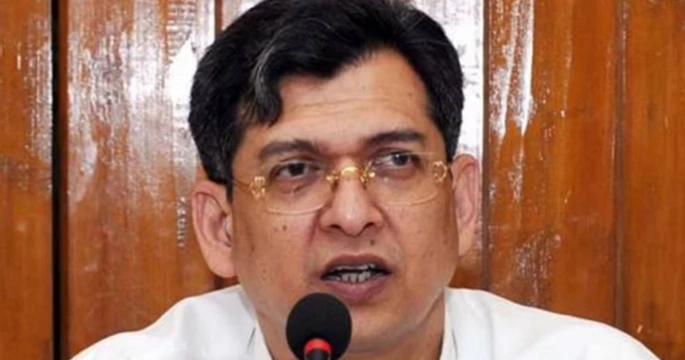
BNP Standing Committee member Salahuddin Ahmed on Monday said those insisting on holding a referendum on the July Charter before the upcoming national election have an ulterior motive to delay the polls.
“The next parliamentary election is only a few months away, and arranging it is already a huge national task. If we try to hold a separate referendum before the election, it will need the same preparations, manpower, logistics, and budget as a general election. This will only waste time and delay the polls,” he said.
The BNP leader made the remark while speaking at a discussion titled 'Challenges and Prospects of Quality and Acceptable Elections' organised by Nagorik Jubo Oikya at the Jatiya Press Club.
He argued that the referendum can easily be held on the same day as the national election, using the same polling stations, officials, and ballot boxes. “This way, we can avoid any attempt to delay the election process,” he observed.
Without naming anyone, Salahuddin said some quarters are still repeating old arguments that a constitutional order must be issued before a referendum. “We think these unnecessary complications should be avoided. The real challenge is not the election itself but the attempts by some to delay it through unnecessary legal and political debates,” he said.
He also said some quarters are trying to create confusion and instability by raising new issues both on the streets and in discussions. “These are the real challenges."
Salahuddin said a referendum on national issues can be held under the existing legal framework without amending the Constitution.
“We have proposed the necessary legal provisions to hold a referendum without changing the constitution. If any constitutional amendment is made, Article 142 says a referendum must be held. But, we have not yet reached the stage of final approval by the President,” he said.
The BNP leader said the government can issue an ordinance or bring an amendment through the RPO to give the Election Commission the power to hold the referendum, and the Commission can conduct it on the same day as the national parliamentary election.”
“The advantage is clear — the same resources, same cost, and the same logistical setup can be used for both votes,” he said, adding that the people of Bangladesh are already used to casting votes on multiple ballots in local government elections,” Salahuddin said.
He said the results of the referendum will be the same, whether it is held on the national-election day or on a separate day.
The BNP leader said he does not understand the question of whether giving two ballots on the same day will create difficulties or confuse the people.
“We are already used to multiple ballots. In local government elections, we give separate ballots for chairman, female members, and male members. Upazila elections have separate ballots for chairman, female vice-chairman, and male vice-chairman. City corporation mayoral elections also use two or three ballots. So, our people are ready,” he said.
For a referendum, the BNP leader said, the Election Commission can easily run campaigns to explain the ballot: a tick in a red box for ‘No,’ a tick in a green box for ‘Yes.’
The question will be simple: do you support the commitments made in the July National Charter? Yes or no. The challenge is to keep it simple. May Allah guide those who try to make it complicated! We all pray that through a fair national parliamentary election, Bangladesh gets a politically stable government and a stable administration,” he said.
Salahuddin said the main actors in elections are the people, voters, the Election Commission, political parties, and law enforcement agencies.
“Everyone doubts whether the current police force can ensure a fair election because morale has not fully recovered. But over 100,000 army personnel will support them, and training is already underway….The most important factor is the people. The people are eager and alert this time, and they will play the main role in ensuring a free and fair election. If anyone tries to cheat, the people will watch and stop them,” he observed.
Salahuddin also expressed hope that Bangladesh will soon hold a free, fair, and participatory election that would ensure political stability and reflect the true will of the people.