Chief Election Commissioner AMM Nasir Uddin on Sunday said the Election Commission is committed to holding a free, fair and inclusive election, addressing the challenges of misinformation and ensuring the participation of women and minorities.
"We are addressing challenges such as misinformation while prioritising the participation and safety of women, minorities and communities in remote areas," he said.
Support through the BALLOT project is vital to strengthening their capacity for both national and future local government elections, said the CEC.
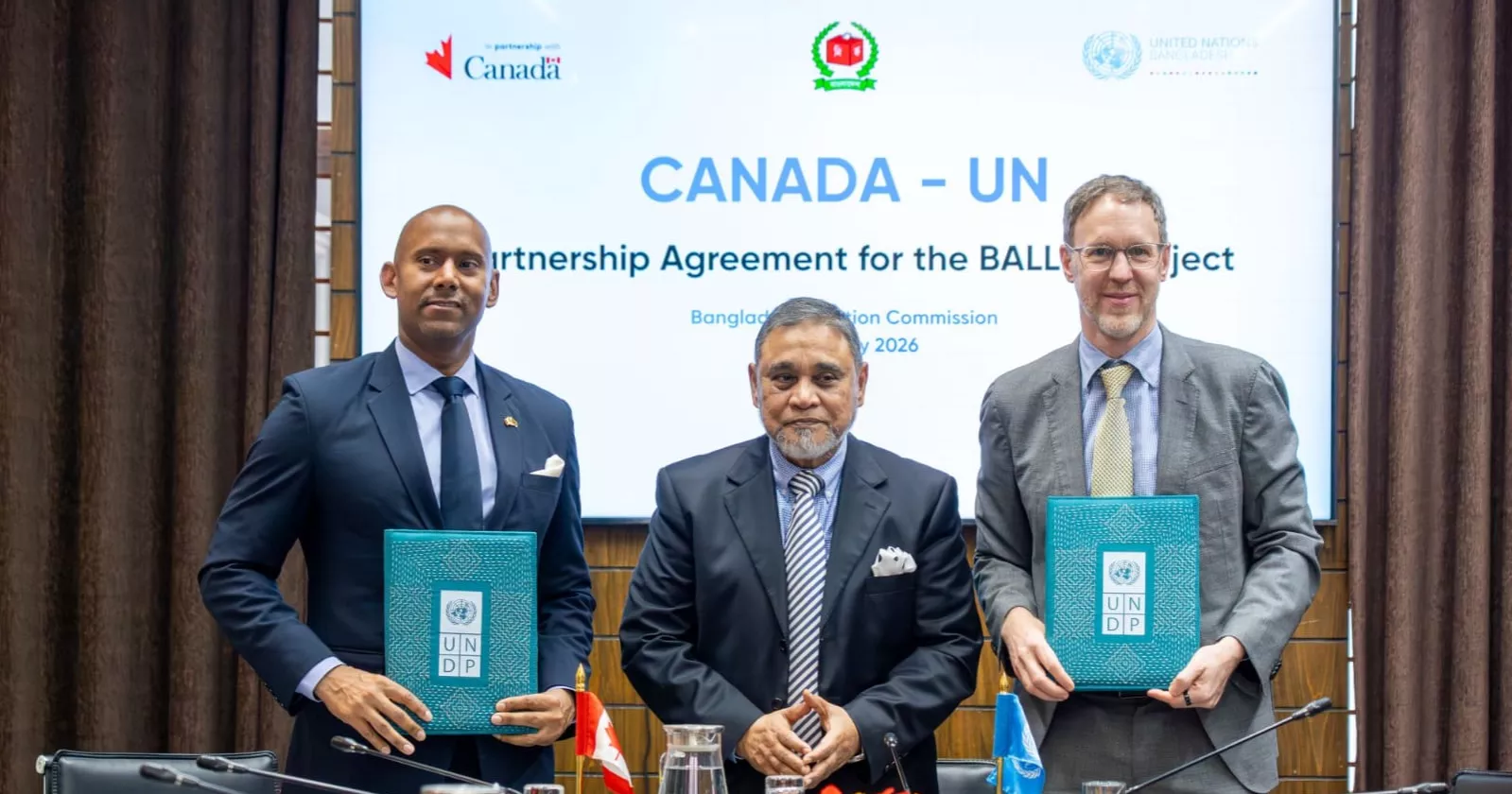
The United Nations Development Programme (UNDP) and the High Commission for Canada in Bangladesh signed a Memorandum of Understanding at the Bangladesh Election Commission to support free, fair and inclusive elections through the Bangladesh Advancement for Credible, Inclusive and Transparent Elections (BALLOT) project for the Electoral Cycle 2025–2027.
The agreement was signed by Stefan Liller, Resident Representative of UNDP Bangladesh, and Ajit Singh, High Commissioner of Canada to Bangladesh in presence of the Chief Election Commissioner.
20 remote polling centres in Rangamati to receive election materials by helicopters
Under the partnership, Canada has approved CAD 2 million to support the BALLOT project in assisting electoral institutions and stakeholders across the electoral cycle.
This support is delivered through a multi‑donor pool fund alongside Australia, Japan, Norway, Sweden, Switzerland, and the United Kingdom.
With national elections scheduled for February 12, the initiative comes at a pivotal moment.
Bangladesh’s election administration is one of the largest in the world, spanning more than 40,000 polling centres across 495 upazilas and serving a population of roughly 168 million people.
The BALLOT project is designed to help ensure that electoral processes are trusted, inclusive and operationally strong.
The project focuses on three core areas including strengthening the institutional and operational capacity of the Bangladesh Election Commission (BEC); enabling a more inclusive and transparent electoral environment; and laying the foundations for long-term electoral sustainability and reform.
It combines immediate technical and operational support with longer-term capacity development and institutional strengthening through 2027.
Ajit Singh highlighted that the partnership underscores Canada’s commitment to democratic institutions and accountable governance.
Prof Yunus happy over polls preparations, says next ‘week very crucial’
“Our contribution to the BALLOT project reflects Canada’s broader engagement in supporting peaceful electoral transitions, and meaningful civic participation across Bangladesh, including youth, minorities, women and girls and indigenous communities,” Ajit Singh said.
Stefan Liller said strengthening electoral systems is central to public confidence and democratic governance. “Canada joins BALLOT, the collective support of the United Nations system to Bangladesh’s electoral process, thereby demonstrating their strong commitment to the country's democratic development.”
The project aligns with Bangladesh’s governance reform priorities, the Sustainable Development Goals, and the United Nations Sustainable Development Cooperation Framework. Progress and results will be monitored under UNDP programming standards, with regular public reporting and outreach.