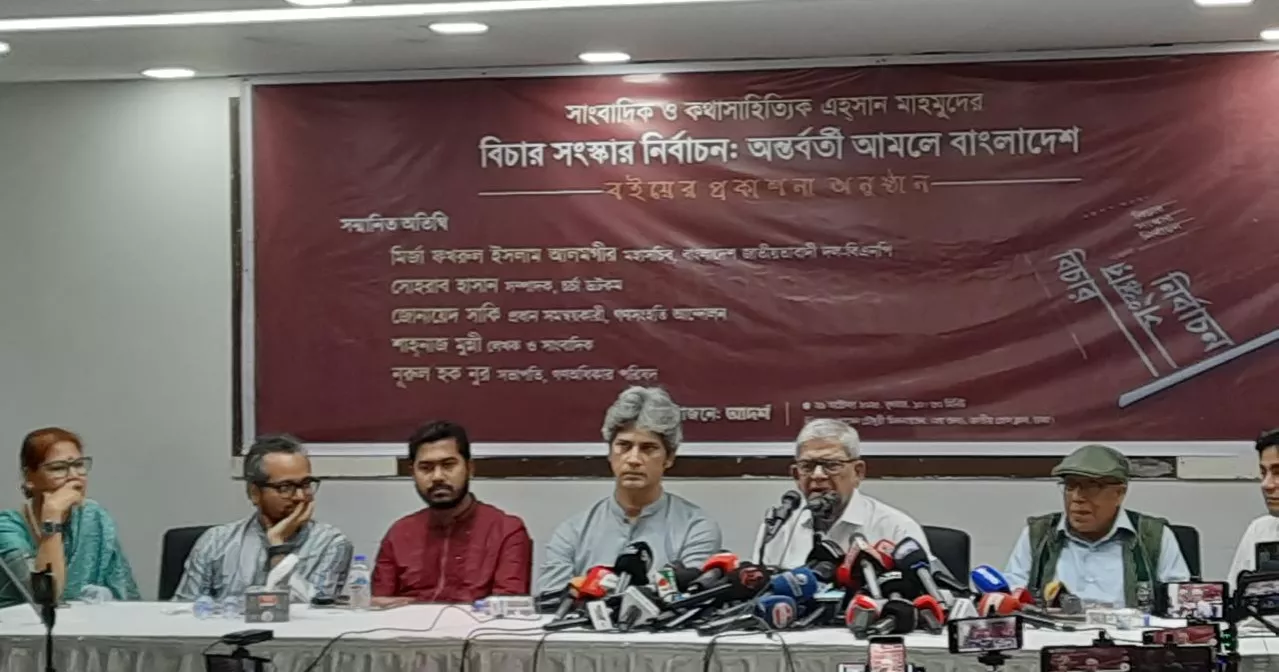
BNP Secretary General Mirza Fakhrul Islam Alamgir on Wednesday accused the National Consensus Commission of deceiving the people and political parties through its final recommendations and demanded an immediate correction by including the notes of dissent.
“The Consensus Commission yesterday (Tuesday) submitted its final recommendations to the Chief Adviser, who is also the Commission’s chairman. We were surprised to see that the issues on which we clearly disagreed, and for which we gave notes of dissent, were completely ignored,” he said.
The BNP leader made the remarks while speaking at the publication ceremony of journalist Ehsan Mahmud’s book ‘Trial, Reform and Election: Bangladesh under Interim’ at the Jatiya Press Club.
He said the Commission earlier promised that all notes of dissent would be recorded.
“But when the recommendations were made public, those notes were completely ignored. This cannot be called a consensus. It is a deception of the people and the political parties. I think these issues must be corrected immediately,” Fakhrul said.
The BNP leader said the root of all problems lies in holding a genuine election through which a people’s parliament will be formed where reforms will then be included in the constitution through that parliament, and the country will be run accordingly.
“I want to draw the attention of the Chief Adviser. You have made a commitment to the people to carry out the necessary reforms and to hold an acceptable election. The parliament formed through that election will be the place to resolve all these crises,” Fakhrul said.
“I would like to make it clear that if there is any deviation from this, or if you go beyond it, you will have to take full responsibility,” he added.
Fakhrul expressed the hope that the government would realise the need for an immediate correction to the Commission’s recommendations, based on the points agreed upon by all parties, and properly record the disagreements.
He said only a credible election can pave the way to form a people’s parliament and restore the rule of the people in the country.
“That’s why, right after the August 5 uprising, we called for an election,” the BNP leader said. “At that time, some people accused us of seeking power and wanting an early election for our own interest. But now it has become clear that the longer this election is delayed, the stronger those fascist forces are becoming,” the BNP leader said.
He said the fascist forces that want to see Bangladesh unstable are trying to push the country towards anarchy and block the genuine establishment of democracy.
Referring to BNP’s position on reforms, Fakhrul said a false campaign has been carried out to portray BNP as opposing reforms.
“We, together with other political parties, launched this anti-fascist movement based on our 31-point proposal, which focuses on reforms. The BNP was born out of a reform process. Yet, a deliberate campaign has been spread claiming that the BNP is against reforms — which is completely false. A party founded through reform can never be anti-reform.”
Fakhrul said that after the Liberation War of 1971, the country came under authoritarian rule led by the Awami League as it introduced a one-party system.
Following the political change in 1975, he said it was the BNP that brought back multi-party democracy and ensured freedom of the media.
Fakhrul said the BNP transformed the country from a presidential to a parliamentary system, and although the party had initially opposed the caretaker government system, it was the BNP that finally passed it in Parliament after holding elections.
“This is the reality — there is no way to deny these facts,” he said. “So, if anyone tries to label the BNP as an anti-reform party, it will clearly be politically motivated and untrue,” he said.
The BNP leader said it was unfortunate that such a major uprising, achieved through immense sacrifice and the loss of many lives, is not being properly used for the nation’s welfare.
“Sadly, as time goes on, divisions are only growing. We must understand who is causing this division and why. In the media, especially on social media, people are taking sides and trying to completely destroy their opponents,” he observed.