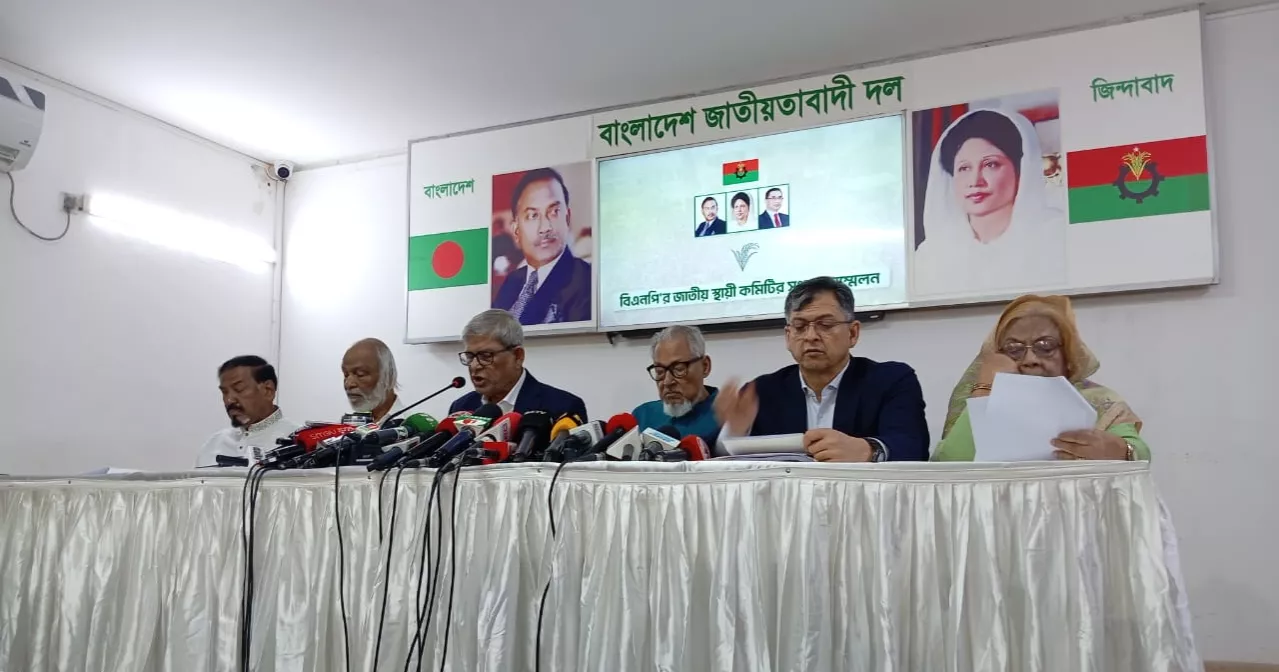
BNP Secretary General Mirza Fakhrul Islam Alamgir on Thursday said the recommendations made by the National Consensus Commission on the implementation of the July Charter were ‘one-sided’ and imposed on the nation.
“The National Consensus Commission has submitted its recommendations to the government to provide a legal basis for implementing the July National Charter. But we cannot agree with the other recommendations of the Commission, as they ignored issues where differences or notes of dissent existed and included matters that were never discussed during the long meetings,” he said.
Fakhrul made the remarks while speaking at a press conference at the BNP Chairperson’s Gulshan office, arranged to convey the outcome of the party standing committee meeting held on Wednesday night.
He said the July National Charter did not mention the opinions, disagreements, or notes of dissent from the political parties that signed it.
“This means the Consensus Commission’s proposals and recommendations have been imposed on the nation in a one-sided way. It is now clear that the year-long discussions between the political parties, the Reform Commissions, and the National Consensus Commission were meaningless — just a waste of time, a mockery and a betrayal of the nation,” the BNP leader said.
He said they are deeply disappointed with the recommendations, arguing that such proposals would divide the nation rather than unite it, and that accepting any arbitrary reform could cause long-term harm to national interest.
Earlier on Tuesday, the National Consensus Commission handed over its recommendations on implementing the July National Charter to Chief Adviser Professor Muhammad Yunus.
Fakhrul said the Commission did not respect the democratic rights and opinions of political parties and even changed some agreed points secretly. “These recommendations have been imposed on the nation.”
The BNP leader said although all parties signed the July National Charter on 17 October based on mutual agreement on reform issues, the final copy was not shown to them that day. Later, when the printed version was released, they found that several agreed points had been changed without their knowledge.
“For example, the clause abolishing Article 4(a) on displaying Sheikh Mujibur Rahman’s portrait in offices was left out, and despite consensus among most parties to repeal Article 150(2) (the Fifth, Sixth, and Seventh Schedules) of the Constitution, the final charter quietly included changes to that as well,” he said.
In reply to a question, Fakhrul said they are not complaining about the recommendations of the Consensus Commission; rather, they are simply presenting their views to the nation. “If needed, we will go to the Chief Adviser again to discuss the matter,” the BNP leader said.
He described the proposal to hold a referendum on the July Charter before the national election as “unjustified.” As the Chief Adviser has already announced that the national election will be held in the first half of February 2026, he said it is not possible to hold the proposed referendum before the election.
“Considering the shortage of time, the huge expenses involved, the deployment of law enforcement and other personnel, and the large-scale arrangements required for a national election, holding a separate referendum beforehand would be unnecessary, illogical, and imprudent. It would be wiser to hold the referendum on the same day as the national election,” the BNP leader said.
Fakhrul hoped that the aspirations of the people and the sacrifices made during the long struggle against fascism over the last 16 years, as well as during the student uprising of 2024, would be honoured by arranging a national election to establish an elected political government and parliament, thus ensuring national unity.
He said BNP’s goal is to build a strong democratic state based on equality, human dignity, and justice through a fair, neutral, and credible national election.
Highlighting BNP’s reform record, Fakhrul mentioned late President Ziaur Rahman’s 19-point programme, Khaleda Zia’s Vision 2030, and Tarique Rahman’s 27 points — later expanded to 31 through consultations with allies — as proof of the party’s commitment to reforms and development.
He said BNP actively took part in the meetings and discussions of both the Reform Commission and the Consensus Commission over the past year and made many compromises in the interest of national unity.
“We sincerely wish success for the ongoing reform process, but as a responsible political party, we must take and express our position to ensure the true welfare of the country and its people,” the BNP Secretary General said.
Fakhrul said the interim government has no legal authority to give constitutional status to the July Charter.
In its letter to the Chief Adviser, he said the Consensus Commission mentioned that the issues of constitutional reform included in the July Charter have been submitted to the government with two alternative methods for implementation and legal endorsement.
“It stated that, to put into effect the constitutional amendments outlined in the July National Charter, the government will issue an order titled ‘July Charter Constitutional Reform Implementation Order 2025’. But the government has no authority to issue such an order,” the BNP leader said.
According to Article 152 of the Constitution, he said, an order holds the status of law, and only the President has the authority to issue it.
Referring to the second alternative proposal, the BNP Secretary General said, “The first alternative proposal states that a full draft bill will be placed for a referendum to implement the July Charter. It also mentions that the referendum will be held on 48 clauses listed in Schedule-1 related to the Constitution, as proposed by the National Consensus Commission.”
But he said the opinions, differing views and notes of dissent of the political parties that signed the July National Charter have not been mentioned in the final printed document.
“It’s natural for political parties in a democracy to have differences of opinion — that’s why dialogue was needed. But the Consensus Commission ignored the democratic right of the political parties to hold differing views,” Fakhrul observed.
He said the recommendations propose forming a Constitutional Reform Council alongside the new parliament, with MPs taking a separate oath as its members. “It means the elected National Parliament will simultaneously be called the 'Constitutional Reform Council.’”
Fakhrul said the Election Commission has authority only to hold parliamentary and presidential elections, not to form such a council — and that the issue was never discussed or agreed upon in talks with the Consensus Commission.
Responding to a question, he said their party’s position is very clear that those involved in the killings and genocide, including Awami League members and government officials, must be brought to justice, and the trials should proceed without delay.
“Our stance on the election is also very clear. We trust the Chief Adviser’s commitment to hold the national election in mid-February 2026, and we are continuing our election activities accordingly,” the BNP leader said.
He said the party does not see any reason for the election to be disrupted. “We have no mistrust towards anyone regarding the election, and we are not worried about it. We want the election to be held promptly and hope it will take place as planned.”
BNP Standing Committee members Dr Abdul Moyeen Khan, Nazrul Islam Khan, Salahuddin Ahmed, Selima Rahman and Hafizuddin Ahmed were present at the press conference.
END/UNB/ARJ/SAM/1825 hrs