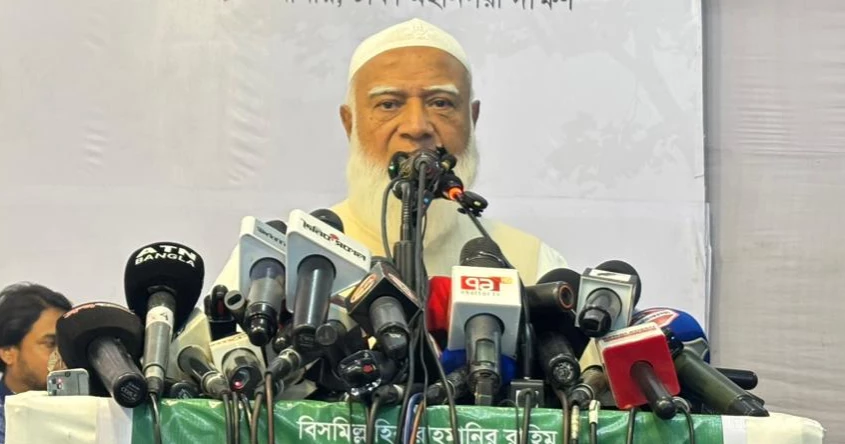
Bangladesh Jamaat-e-Islami Ameer Dr Shafiqur Rahman on Monday accused a section of political players of attempting to rehabilitate ‘fascist forces’ and push Bangladesh back to what he described as a ‘rotten past’, warning that the nation would not forgive them if they failed to reform.
“They have already been identified. For years they remained disguised; now their true face has been exposed,” he said while addressing a discussion meeting organised by Bangladesh Jamaat-e-Islami, Dhaka Metropolitan South, at the Jatiya Press Club.
The Jamaat chief urged the collaborators of fascists to repent, apologise and refrain from wrongdoing. “Otherwise, the nation will not forgive you.”
Paying tributes to those who sacrificed their lives in the 1971 Liberation War and to victims of alleged repression during what he termed ‘15 and a half years of fascist rule’, Shafiqur Rahman said political parties, religious scholars, civil society members and journalists had all faced killings, enforced disappearances and persecution.
Referring to the July 24 mass uprising, he said the actual number of martyrs remained unknown and was likely higher than available figures.
He expressed deep concerns over the condition of Inquilab Moncho spokesperson Sharif Osman Hadi, who was critically injured in a shooting and has been taken to Singapore for treatment. “We pray that Allah restores him to us,” he said.
The Jamaat chief also criticised a recent remark by the Chief Election Commissioner, saying it had hurt public sentiment.
He urged the CEC to clarify his statement and prove his neutrality, noting that the nation had not received it positively.
While acknowledging government steps regarding Hadi’s treatment, Shafiqur Rahman said such responses should not come only after lives are pushed to the brink.
He urged the authorities to ensure public safety so that no one dares to show such audacity again.
On calls for resignations from officeholders, he said stepping down was not the solution. “Prove your eligibility by fulfilling your responsibilities,” he said, warning that failure could invite renewed unrest—something he said Jamaat does not desire.
Calling for a united, humane and corruption-free Bangladesh, he said the party seeks “unity, not division; love, not violence; transparency and accountability, not corruption; justice for all; and jobs in hand, not black money.”
He said Jamaat would work with all forces committed to three principles: zero tolerance for corruption, an independent judiciary free from political interference, and sincere implementation of agreed reform proposals. “Those who agree on these will find our doors open,” he said.
Stressing respect for both 1971 and 2024, he said denying anyone’s contribution would harm the nation’s future.
“July 24 is not just history; it is part of our very being,” he said.
Pointing at journalists, Shafiqur Rahman urged accurate and complete reporting, cautioning against selective quotations that could mislead the public.
He reaffirmed Jamaat’s support for free, responsible media, including fair criticism, provided it is grounded in truth and national interest.
Central Executive Council member and Dhaka South Ameer Mohammad Nurul Islam Bulbul presided over the programme.