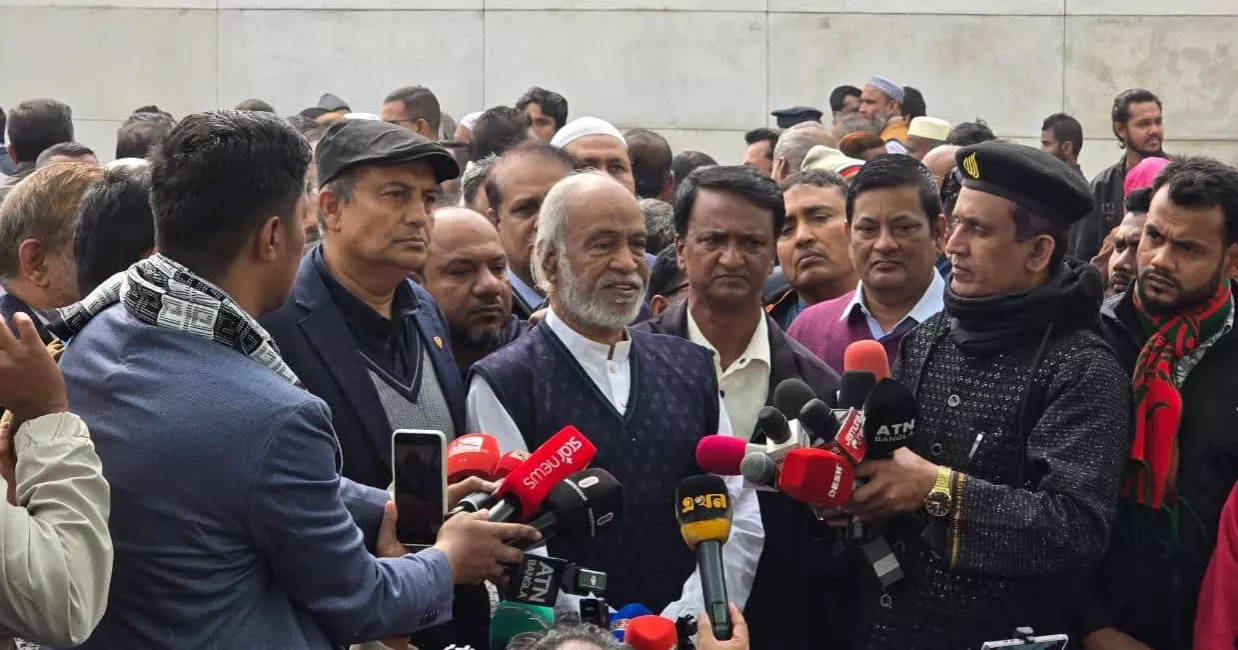
BNP senior leader Dr Abdul Moyeen Khan on Monday described Khaleda Zia as an exceptional leader whose name is closely linked with Bangladesh’s political journey, democratic movement, and the long struggle to establish people’s voting and fundamental rights.
“Khaleda Zia is a unique name in the history of Bangladesh, the history of democracy, the struggle to establish people’s rights and voting rights, and the history of freedom of speech,” he said.
Dr Moyeen, a BNP Standing Committee member, made the remarks while talking to journalists after visiting the grave of former Prime Minister and BNP Chairperson Begum Khaleda Zia at Zia Udyan in the capital.
Earlier, the BNP leader, along with leaders of the Agriculturists Association of Bangladesh, paid tributes to Khaleda Zia by placing a wreath at her grave.
Top business leaders meet Tarique Rahman, discuss economy, jobs
He said Khaleda Zia fought continuously for 16 years from 2009 against what he described as the Awami League government’s one-party rule and always raised her voice for the people.
Recalling his earlier remarks in parliament, Moyeen Khan said he once described Begum Khaleda Zia as the ‘great woman of the House’.
“Today, we have no words to express our grief. All we can say is that Begum Khaleda Zia was a woman who devoted her life to the people of Bangladesh after responding to the call of millions, rising from a housewife to a national leader,” he said.
The BNP leader said Khaleda Zia dedicated her entire life to democracy and the rights of people.
Mentioning her uncompromising political stance, he said many political leaders in Bangladesh, at different times, made compromises for personal or party interests. “But Begum Khaleda Zia was an exceptional personality who proved through her life that the country’s interest and the cause of democracy always came first for her.”
Dr Moyeen said the BNP chief ignored her own personal comfort to establish people’s rights and freedoms.
Recalling how Khaleda Zia faced repression and torture at the hands of a military regime in the 1980s and during the last 17 years, the BNP leader also said she never practised politics sitting in air-conditioned rooms.
“She stood with people and did politics from the streets. She moved forward with the people. Her strength came from the people, not from guns,” he said.
For the sixth consecutive day, a large number of people continued to visit the grave of late Khaleda Zia at Zia Udyan, reflecting the deep impact she had on Bangladesh’s politics.
BNP leaders and activists, along with people from all walks of life, gathered at the grave to pay tribute to her.
From Monday morning, programmes of Quran Khatam were held, and visitors took part in prayers with raised hands, seeking divine blessings for the departed leader.
Many said they came to the grave to ease their grief as they could not attend her janaza, offering fateha and prayers.
Senior BNP leaders, including the party’s top leadership and the nominated candidate for Dhaka-13 constituency, visited the grave during the day. After offering floral tributes, they spoke to journalists.
Apart from Dr Moyeen Khan, BNP Vice Chairman Shamsuzzaman Dudu also visited the grave and paid homage to Khaleda Zia.
Later talking to reporters, he said Begum Khaleda Zia won the hearts of the people and that following her path means following the path of democracy. “We want to protect the country. There is an attempt to create disorder, but we want peace.”
Dudu said BNP Acting Chairman Tarique Rahman will take on the leadership role, adding that Khaleda Zia prepared him as a capable leader. “There is no alternative to the sheaf of paddy. People are eager to vote for the sheaf of paddy.”
Dudu said the party will soon unveil its election manifesto, outlining how it plans to run the country if elected to power.