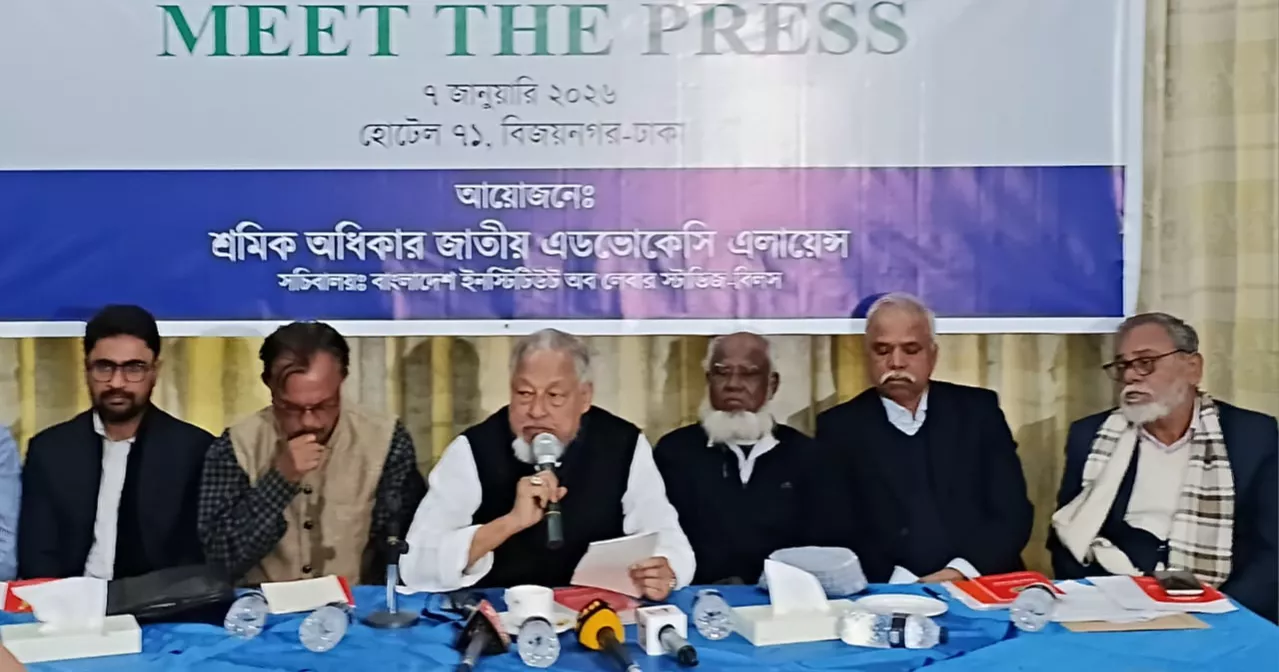
The 'National Workers' Rights Advocacy Alliance' on Wednesday formally presented a 15-point "Worker Manifesto" to political parties, urging them to prioritize labor rights and social justice in their upcoming electoral agendas for the 2026 National Parliament Election.
The demand was revealed in a press conference held at a city hotel. Alliance leaders called for a unified political commitment to ensure that those who rise to power through the sacrifices of the working class do not forget the rights of those workers.
Nazarul Islam Khan, Convener of the Alliance and BILS Secretary General, added that the manifesto would be taken to workers at the grassroots level while maintaining active advocacy with national policymakers.
"This is not just about handing over a document; it is about building a national understanding that the welfare of the working class is central to the nation's progress," Khan noted.
A Call for Political Accountability
"Those who come to state power through the blood of workers must not forget the issue of workers' rights," stated Syed Sultan Uddin Ahmed, Member Secretary of the Alliance and Executive Director of the Bangladesh Institute of Labour Studies (BILS).
He emphasized that while workers are often at the frontlines of national movements, their contributions are frequently overlooked once political transitions occur.
Key Recommendations of the 15-Point Manifesto. The manifesto outlines a comprehensive roadmap for labor reform, including:
Legal Recognition: Amendments to labor laws to ensure legal protection and registration for all categories of workers.
2.Fair Wages: Establishing a national minimum wage that ensures a dignified standard of living.
3. Safety and Compensation: Enhancing workplace safety, increasing accident compensation, and ensuring transparent investigations of all workplace mishaps.
4.Social Protection: Providing essential services such as rationing, housing, and healthcare for laboring families.
5.Union Rights: Guaranteeing the right to organize and collective bargaining, including for workers in Export Processing Zones (EPZs).
6.Gender Equality: Eliminating harassment and violence at work and increasing paid maternity leave to six months for all female workers.
7.Future Challenges: Addressing the impacts of climate change, automation, and the fourth industrial revolution on the workforce.
8.Permanent Labor Commission: Forming a National Permanent Labor Commission to resolve crises and ensure administrative accountability.
The alliance, a joint platform of national trade union federations and labor rights organizations, expressed hope that these recommendations would lead to a more inclusive and discrimination-free Bangladesh.
Senior Joint Convener Mesbahuddin Ahmed and other labour leaders, including representatives from the Bangladesh Jatiyatabadi Sramik Dal, Combined Garment Workers Federation, and Naripokkho, were present at the event.
They collectively urged all candidates and political parties to view labor issues as a primary policy priority, noting that the sheer volume of the labor vote makes it an indispensable factor in national planning.