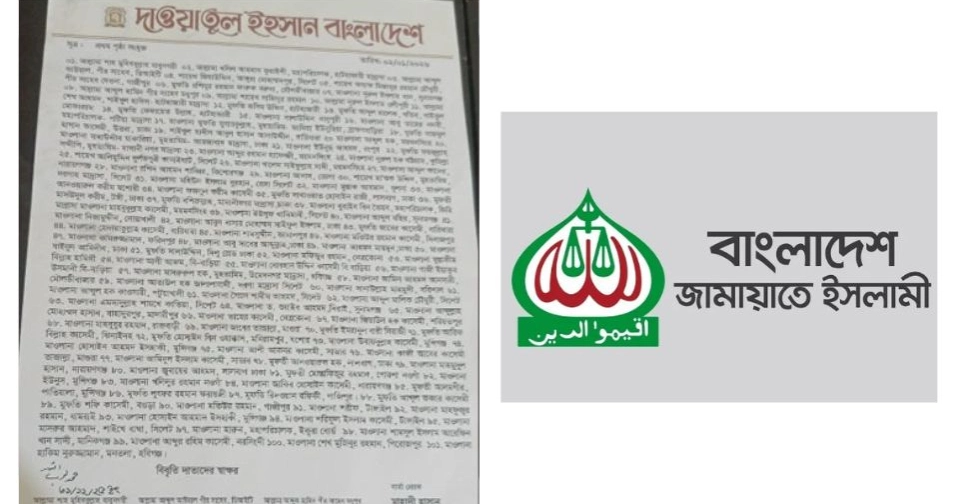
A group of 101 leading Islamic scholars in Bangladesh has stated that the recently formed Jamaat-led political alliance cannot be recognized as an Islamic bloc.
The statement, issued through Dawatul Ihsan Bangladesh, emphasized that faith and creed take precedence over electoral agreements, and alliances formed solely for political purposes cannot represent true Islamic unity.
The scholars warned that labeling the coalition as “Islamic” misleads ordinary Muslims and weakens doctrinal clarity. They stressed that parties or groups whose ideology contradicts Sunni beliefs, the principles of the Prophet, and the example of his companions cannot form a legitimate Islamic alliance. Any compromise on matters of faith, they said, undermines the fundamentals of Islam and misguides the public.
The statement outlined three key principles of Islamic political conduct. First, the inclusion of “Islam” or “Islamic” in a party’s name does not automatically make it an Islamic political group. True Islamic politics must adhere to Sunni creed, follow the Quran and Sunnah, and maintain distance from all anti-religious compromises. Second, parties committed to Sunni teachings cannot ally with groups that promote ideas contrary to the faith. Third, Islamic politics is not a mere strategy for power; it should safeguard religion, uphold Shariah values, counter un-Islamic ideologies, and protect the faith of the community.
Signatories include leading scholars from across Bangladesh, such as Allama Shah Muhibbullah Babunagari, Allama Khalil Ahmad Quraishi, Allama Abdul Hamid Pir, Allama Ziauddin, Mufti Rashidur Rahman Faruk, Allama Nurul Islam Khan, and many others.
The scholars urged religious organizations, fellow scholars, and the Muslim community to remain alert, avoid confusion, and not recognize the Jamaat-led bloc as an Islamic political alliance, reaffirming the importance of doctrinal clarity and faith-based politics in Bangladesh.