Syed Moazzem Hossain Alal, adviser to the BNP Chairperson, has said that those who led the mass uprising should not have become part of the current government, adding that the pressure they could have exerted from the outside has significantly decreased now.
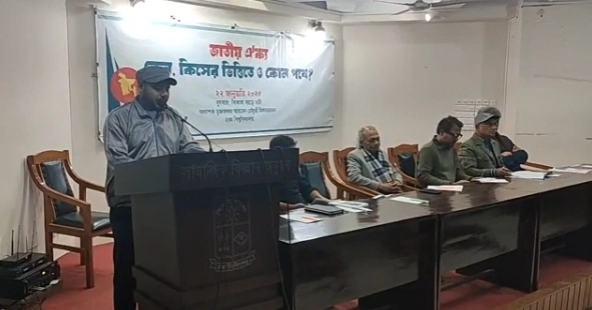
He made the remarks on Wednesday during a discussion titled ‘National Unity: Why, on what basis, and which path?’ organized by Unity for Bangladesh at the Muzaffar Ahmed Chowdhury Auditorium of Dhaka University.
Alal said, “If we consider the July uprising as a war, another aspect to consider is who has won in that war. It’s also important to determine who remains and who doesn’t. Then, we need to consider on what terms anyone should remain. The general public expected a statement from the Awami League and its allies, stating that they are regretful, that they have committed wrongs, and they seek forgiveness. Even those who were silent supporters of the Awami League expected this, that during the six months from August to January, at least six leaders will apologize publicly. But none of them showed this spirit.”
No scope for reforms without democratic process: Khosru
“Personally, I believe that those who led the student-people's movement should not have become part of the current government. The pressure they could have applied from the outside has been greatly reduced now,” he said.
Referring to the basis of unity, he said, “At one time, we had some national-level leaders or guardians who mediated during various crises. Now, I don’t sense that we have such leaders or guardians among us. Those who could have played that role have been humiliated and sidelined, leading to their estrangement. Now, they do not wish to take up that responsibility.”
“Institutions have been destroyed. Political culture in countries like India and many parts of Europe may be murkier than ours, but their institutions are incredibly strong. We have failed in that regard since our independence. If we had built our institutions properly, at least people would have thought before engaging in wrongdoings. We should focus on strengthening unity in this regard,” Alal said.
BNP, Khelafat Majlis agree on holding elections by 2025
Ragib Ahsan Munna, General Secretary of the Communist Party of Bangladesh (CPB) and former VP of RUCSU, said, “The term unity is not new in Bangladesh. In 1952, unity based on language laid the foundation for a new state. Similarly, unity was needed in 1969 and 1990. Unity had to be formed with specific goals and demands. However, after the 2024 uprising, a new demand for unity has emerged. Through this uprising, a new political demand has come to the forefront. If we want to see its implementation, we must dismantle the old political management and governance structure.”
He further said, “The current change in Bangladesh is about who will control resources and dominate politics. All previous changes were brought about by the proponents of the capitalist system, that failed to provide a peaceful solution. Therefore, unless we free society from the grip of capitalism, we will fail again.”
Delhi turns into safe haven, central office of ‘Awami fascism’: Rizvi
New Age Editor Nurul Kabir, Chief Coordinator of the Gana Samhati Andolon Zonayed Saki, educationist and geopolitical expert Lieutenant General (retd) Aminul Karim, Dr. Snigdha Rizwana, an anthropology professor at Jahangirnagar University, and Tuhin Khan also spoke at the discussion.