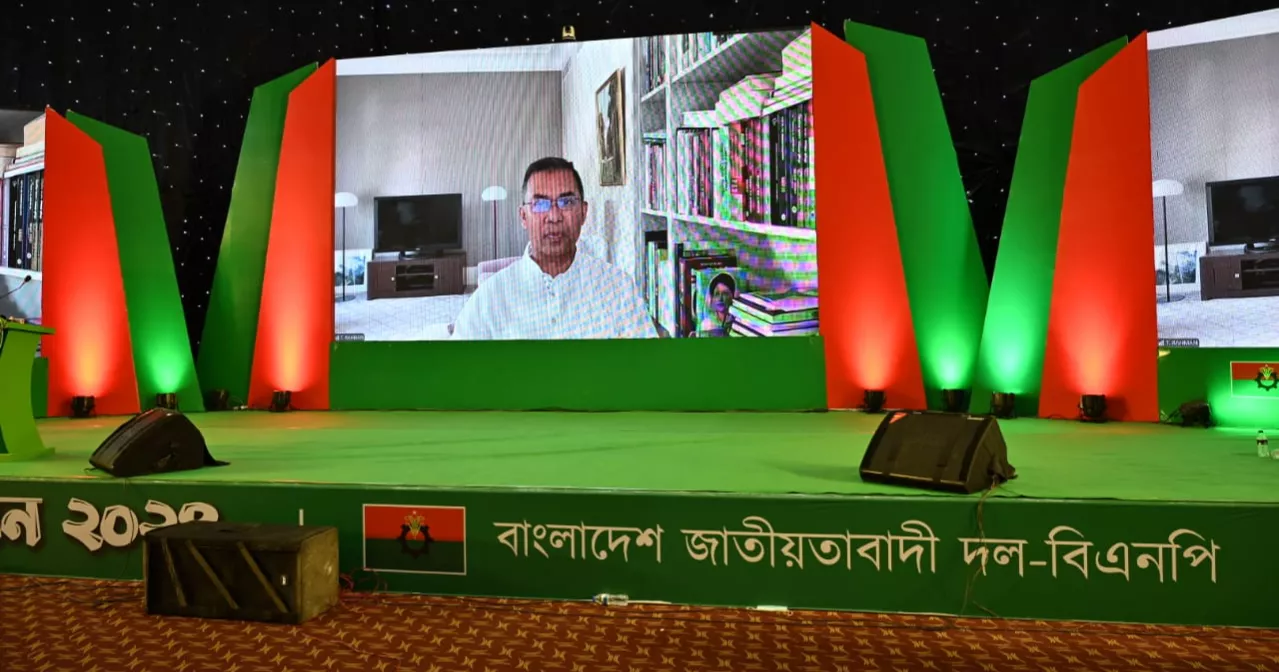
Stating that people’s unity is now more important than ever, BNP Acting Chairman Tarique Rahman on Tuesday urged political parties to carefully consider whether the proportional representation (PR) election system is suitable for Bangladesh, warning that it could lead to division.
“Some political parties have raised the demand for a proportional representation (PR) electoral system. While this system of elections exists in certain countries around the world, I urge everyone to carefully consider how suitable—or whether it is suitable at all—for Bangladesh at this moment, given the country’s current reality and its geographical-political context,” he said.
Tarique made the remarks while virtually addressing the party’s discussion, ‘Mass Uprising 2024: National Unity and Democratic Journey’, held at the China-Bangladesh Friendship Conference Centre in the capital.
To establish Bangladesh on a strong democratic foundation, he said the country must be freed from subservience.
“At this moment, national unity is more important than ever. But I would like to humbly appeal to the leaders of all political parties to seriously consider whether the proportional representation system could lead to a divided society and an unstable government instead of national unity,” the BNP leader said.
He said all parties need to seriously consider whether, under the cover of the proportional representation electoral system, they are unknowingly being used to rehabilitate a previously defeated, fugitive and deposed dictator into Bangladesh’s politics.
The BNP leader said the interim government remains active in arranging a national election to establish a government that will be accountable to the people through their direct votes.
At the same time, he said, the government has started the trial of the ousted fascists and begun reforms in the state and politics.
Mentioning that reforming the state and politics is an ongoing process, Tarique said he firmly believes that the future government elected by the people will continue the work started by the interim government to ensure democracy and the rule of law in both the state and society.
Khaleda calls for upholding unity, quick steps to institutionalise democracy
“So, democracy-loving people believe it is logical not to link one issue with the conditions of another,” he observed.
In the reform process initiated by the interim government, the BNP leader said political parties are making thoughtful proposals. “Everyone is putting forward good suggestions keeping people in mind. But it is important to consider whether all these proposals are truly suitable in the context of Bangladesh.”
He warned that if political parties continue to raise new issues one after another, conspirators might find a chance to re-emerge.
Noting that it is not possible for the interim government to solve every problem of the people, he said, “If we keep the interim government constantly occupied with reform matters, it may end up depriving the people of their political and economic rights.”
He said there is now an opportunity to build a democratic and discrimination-free Bangladesh as the country has been freed from fascism through the mass uprising.
The BNP leader said establishing democracy and forming an elected government through a fair national election is necessary to honour the sacrifice of the martyrs.
Tarique Rahman expressed his respect to the martyrs and conveyed his sympathy to the families of those who were martyred or injured during the mass uprising and the long democratic movement.
He said just as people have not forgotten those who laid down their lives for the country’s independence in 1971, the nation will also not forget those who were martyred during the mass uprising in 2024.
If BNP comes to power, Tarique said, the party will name various state institutions and establishments after the martyrs in their honour.
Tarique reiterated that if the BNP is voted to power in the next national election, it will form a national government.
“This government will make the highest effort to carry out every programme for the development of the country and its people. To build a corruption-free, safe, humane, and democratic Bangladesh, it is important that all democracy-loving individuals, organisations, and political parties come together,” he said.
Although differences in views and programmes may seem to cause division among anti-fascist political parties, the BNP leader said he strongly believes all democratic forces are united in the national interest.
Tarique inaugurates BNP’s 36-day programme marking July Uprising anniversary
“It is not necessary for all political parties to agree on every issue, but agreeing on national interest is most important… I firmly believe, and our party BNP believes, that this anti-fascist national unity will stay strong and, Insha’Allah, it will continue in the future,” he said.
Tarique made a call to all, saying, "Let us not be guided by revenge or hatred. Let us begin a competition of light, a competition of goodness to build the Bangladesh our martyrs dreamed of. Let us come out from the darkness of fascism and return to the light of democracy."
He also called upon all leaders, activists, supporters, and well-wishers of BNP and every democratic political party in Bangladesh not to increase more conditions or demands. “Instead, let us try to understand Bangladesh through the spirit of the martyrs."
"Let us try to see Bangladesh through the inner vision of those who lost their eyes in battle. Let us feel the pain of the injured and the suffering, and build Bangladesh in the light of the martyrs’ hopes,” he said.
BNP Secretary General Mirza Fakhrul Islam Alamgir said many sacrifices have to be made to free the country from the Awami League’s fascist rule.
The BNP leader said the mass uprising has created a chance to build a new democratic Bangladesh.
He said a false campaign has been run to portray BNP as being against reform, which is not true.
“We will not compromise when it comes to unity and democracy. As a liberal democratic party, we want change through democratic means and in parliament. I ask all to consider this positively,” Fakhrul said.
About the July Charter, he said BNP had already extended its support to finalise it. “Now it is the government's responsibility to complete the process.”
BNP Standing Committee member Mirza Abbas said certain quarters are subtly trying to keep BNP from coming to power, as the party has a strong chance of winning the next election.
“Many parties are making various demands to disrupt the election, which is contributing to national disunity… We must stay united to move the country forward.”
BNP Standing Committee member Salahuddin Ahmed said national unity against fascism must be upheld, adding, “It will be our strength in building a new Bangladesh.”
Jamaat Assistant Secretary General Abdul Halim, 12-party Alliance Chief Coordinator and Jatiya Party (Kazi Zafar) Chairman Mustafa Jamal Haider, Nagorik Oikya President Mahmudur Rahman Manna, Bangladesh Jatiyo Party (Manzu) Chairman Andaleeve Rahman Partho, Chief Coordinator of Ganosamhati Andolon Zonayed Saki, NPP Chairman Fariduzzaman Farhad, Labour Party Chairman Mostafizur Rahman Iran, Biplobi Workers' Party Saiful Haq, Nizam-e-Islam Party Chairman Ashraful Islam, AB Party Chairman Mujibur Rahman Manju , Former MP and JSD General Secretary Nazmul Haque Prodhan, National Democratic Movement (NDM) Chairman Bobby Hajjaj, Gono Gono Odhikar Parishad General Secretary Muhammad Rashed Khan, spoke at the programme.
Family members of the martyrs of the July-August uprising and the democratic movement, along with families of the victims of enforced disappearance, sat in the front row of the event.
They held photos of their loved ones who were killed or became victims of enforced disappearance.
On behalf of BNP, the party Secretary General gave crests to the families of the martyrs.
Tarique Rahman also inaugurated the party’s 36-day-long programme titled ‘July-August Uprising: Mourning and Victory Observance’, marking the first anniversary of the July-August mass uprising.
A deeply emotional moment unfolded as the families of those killed during mass uprisings and democratic movements, as well as victims of enforced disappearances, shared their sorrow and grief over the loss of their loved ones.
Many in the audience, including Tarique Rahman, were seen wiping away tears, moved by the speeches of the family members of the martyred and enforced disappearance victims.
BNP leader Salahuddin questions mandatory consensus on NCC proposals
Martyred Abu Sayed’s elder brother Ramjan Ali, Mir Mahfuzur Rahman Mugdho’s father Mostafizur Rahman, Wasim Akram’s father Safiul Alam, Yamin’s father Mohiuddin, Abdullah bin Zahid’s mother Fatima Tuz Zohr, Farhan Fiaz’s sister Saima Islam Farin, Kazi Fahim’s mother Kazi Lulfa, missing BNP leader M Ilias Ali's wife Tahsina Rushdir Luna, Sanjida Islam Tuli, coordinator of Mayer Daak, a platform for family members of enforced disappearance victims, enforced disappearance victim and BNP leader Anisur Rahman Talukdar, Adiba Islam Hridi, daughter of enforced disappearance victim and Chhatra Dal leader Parvez Hossain, crossfire victim Nuruzzaman Jony’s brother Moniruzzaman Hira, as well as the fathers of Biswajit and Abrar Fahad, who were brutally killed by ruling party cadres during the Awami League’s rule, Redwad Hossain Riyad, who lost his eyes in police firing during the mass uprising, and Navil, who was maimed in a police shooting, also spoke at the programme.