
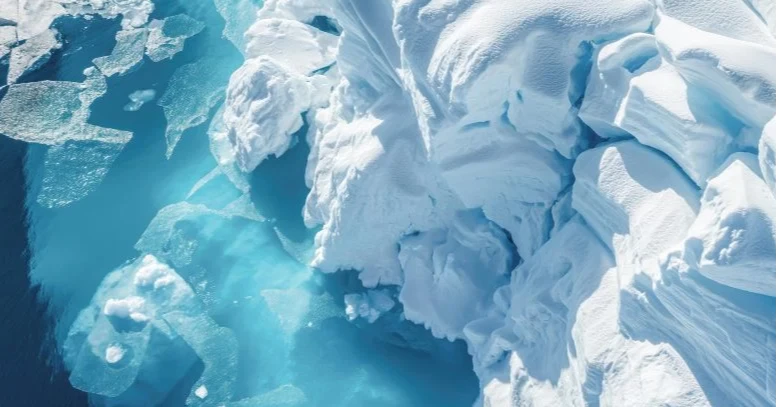
A new 30-year study by glaciologists from the University of California, Irvine has produced the first comprehensive map showing how Antarctica’s grounding line — the point where land ice meets the ocean — has shifted over time.
Using three decades of satellite data, researchers found that while most of the continent has remained relatively stable, several vulnerable regions are losing large amounts of grounded ice. The total loss between 1996 and 2026 reached about 12,820 square kilometers, an area roughly equal to 10 cities the size of Greater Los Angeles.
The research, published in the Proceedings of the National Academy of Sciences, shows that 77 percent of Antarctica’s coastline has experienced no grounding line movement since 1996.
However, major ice retreat has been recorded in parts of West Antarctica, the Antarctic Peninsula, and some areas of East Antarctica. On average, Antarctica’s ice sheet has retreated by about 442 square kilometers per year.
The most dramatic changes were observed in the Amundsen Sea and Getz regions of West Antarctica. Several major glaciers have pulled back significantly, including Pine Island Glacier, which retreated about 33 kilometers, Thwaites Glacier by 26 kilometers, and Smith Glacier, which moved back 42 kilometers, one of the largest shifts recorded.
Moon’s shrinking raises questions for future lunar missions
Lead author Eric Rignot said warm ocean water reaching glaciers is a key driver behind these changes, eroding ice from beneath floating ice shelves and weakening the glaciers.
To conduct the study, scientists combined satellite data from numerous international missions, including those from the European Space Agency, NASA, German Aerospace Center, and other global partners, as well as commercial satellite providers.
The findings will help improve ice-sheet models used to predict future sea-level rise, providing a crucial benchmark for scientists studying how Antarctica may respond to climate change.
Researchers say the results also highlight that while large parts of Antarctica remain stable for now, continued monitoring is essential because ongoing ice loss in vulnerable regions could significantly influence global sea levels in the future.
#From Scitech Daily