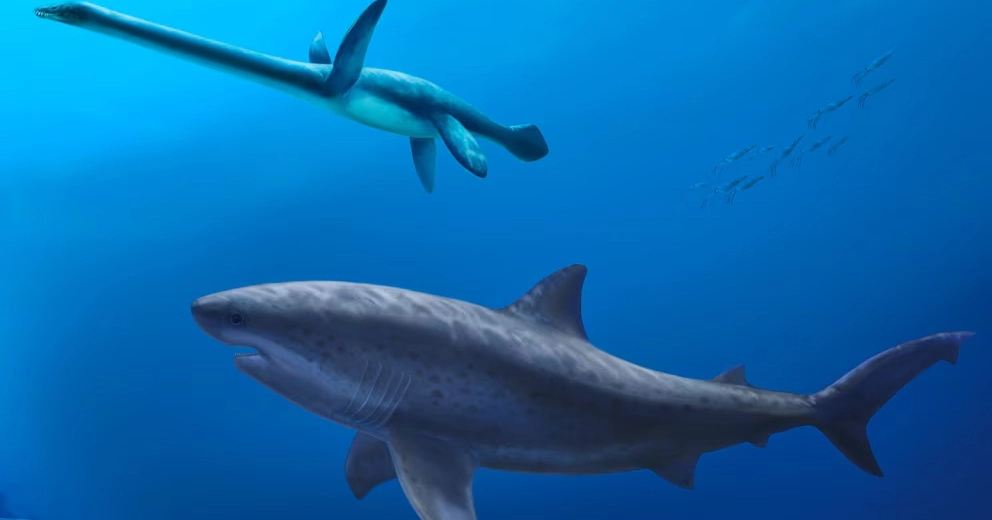
Long before whales, great white sharks, or the massive megalodon, enormous predatory sharks ruled the waters off what is now northern Australia during the Cretaceous period.
Researchers examining large vertebrae discovered near Darwin identified the creature as the earliest known mega-predator in the lineage of modern sharks, living some 15 million years earlier than previously known giant sharks. Estimated at around 8 meters (26 feet) long, it dwarfed the ancestors of today’s 6-meter (20-foot) great white sharks, according to a study in Communications Biology.
NASA loses contact with Maven spacecraft orbiting Mars for a decade
“Cardabiodontids were ancient, mega-predatory sharks common after 100 million years ago, but this discovery pushes back the timeline for finding enormous specimens,” said Benjamin Kear, senior curator in paleobiology at the Swedish Museum of Natural History.
The vertebrae, originally unearthed in the 1980s and 1990s and stored in a museum, provided crucial size clues, as shark skeletons are mostly cartilage and teeth are often the only fossils available. Using CT scans, mathematical models, and fisheries data, the team estimated the predator’s body size and shape, which closely resembled a modern giant shark.
The findings suggest modern sharks reached top predator status early in their evolution. Studying such ancient ecosystems could also help scientists predict how today’s species may respond to environmental changes, offering insights into both the past and the future of marine life.
Source: AP