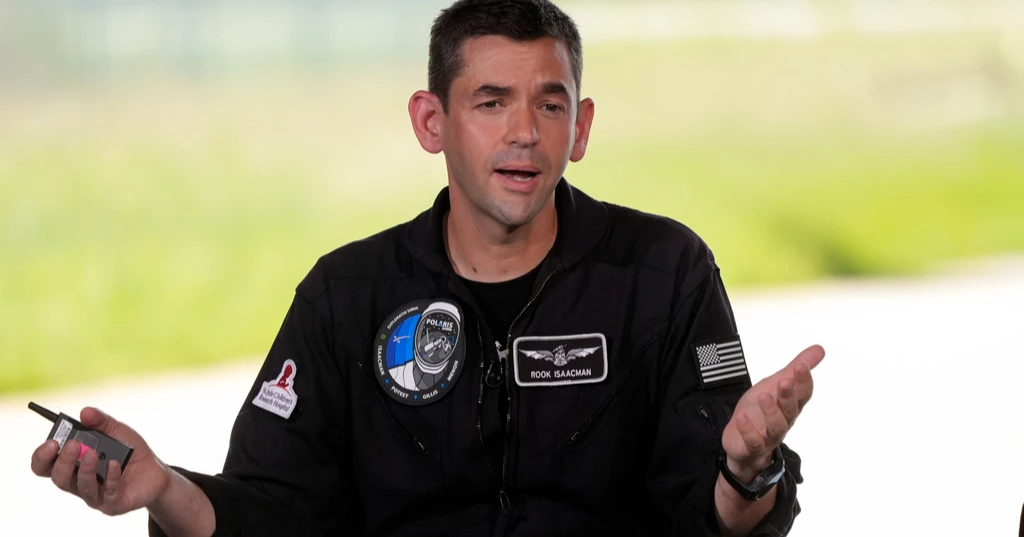
Billionaire spacewalker Jared Isaacman, nominated for NASA's top position, presented his vision for space exploration, focusing on sending astronauts to Mars.
President Donald Trump nominated Isaacman to be NASA's 15th administrator in late 2024. If confirmed, the 42-year-old tech entrepreneur would become the youngest person to lead NASA, a space agency aiming to return astronauts to the moon. Isaacman would also be one of the few administrators to have personally flown in space.
The Senate Commerce, Science, and Transportation Committee met in Washington for the nomination hearing. Isaacman, in his written testimony, affirmed, “As the president stated, we will prioritise sending American astronauts to Mars. Along the way, we will inevitably have the capabilities to return to the Moon.”
Isaacman, who has flown to space twice, funded his trips through SpaceX and made history last September with the first private spacewalk. He built his fortune through Shift4, a payment processing company he started as a high school dropout in his parents' basement.
Acknowledging his unconventional candidacy, Isaacman said in his testimony, “I have been relatively apolitical; I am not a scientist, and I never worked at NASA. I do not think these are weaknesses.”
The space community, aware of Isaacman’s close ties with SpaceX’s Elon Musk, awaited his stance on lunar and Martian exploration. Among the audience were four astronauts, including three U.S. astronauts and one Canadian, who are set to participate in NASA’s planned moon mission next year.
NASA has long considered the moon as the next logical step in human space exploration. The Artemis program aims to send a crew around the moon in 2026 and land astronauts near the moon’s south pole by 2027. Unlike the Apollo missions, Artemis plans to establish lunar bases rather than brief visits.
However, the Artemis program has faced slow progress and rising costs, particularly with NASA’s Space Launch System rocket, which has only launched once, in 2022, without a crew. Musk, on the other hand, supports Mars as the ultimate destination and is pushing forward with more test flights for Starship, the world’s largest and most powerful rocket.
By making Starship reusable, Musk intends to dramatically reduce the cost of sending humans and cargo to Mars. NASA has selected Starship for the first two astronaut landings on the moon as part of the Artemis program.