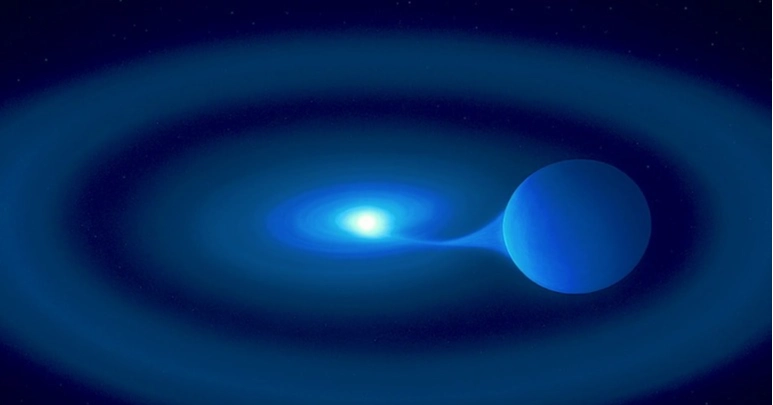
A dead star located 10,000 light-years away could explode in a spectacular supernova that may be visible to the naked eye from Earth — even during the day, according to a new study.
The star system, known as V Sagittae, features a white dwarf that has been feeding on its companion star, pulling in mass as the two orbit each other every 12.3 hours. Scientists say the stars are spiraling closer together in what they describe as an “extraterrestrial tango.”
“V Sagittae is no ordinary system — it’s the brightest of its kind and has baffled astronomers since its discovery in 1902,” said Phil Charles, a researcher at the University of Southampton and a member of the international team behind the study. “Its extreme brightness comes from the white dwarf sucking material from its companion, fueling a blazing inferno on its surface. The process is so intense it is going thermonuclear, shining like a beacon in the night sky.”
Using the European Southern Observatory’s Very Large Telescope in Chile, researchers discovered a massive halo-like ring of gas surrounding the system, formed from matter the white dwarf could not consume. The presence of this halo indicates that the star is devouring material at an unsustainable rate.
“This build-up of matter will likely trigger a nova outburst in the coming years, making V Sagittae visible with the naked eye,” said Pablo Rodríguez-Gil of Spain’s Instituto de Astrofísica de Canarias.
He added that when the two stars ultimately collide, the resulting supernova explosion would create a dazzling spectacle visible even in broad daylight.
The findings were published in the journal Monthly Notices of the Royal Astronomical Society.