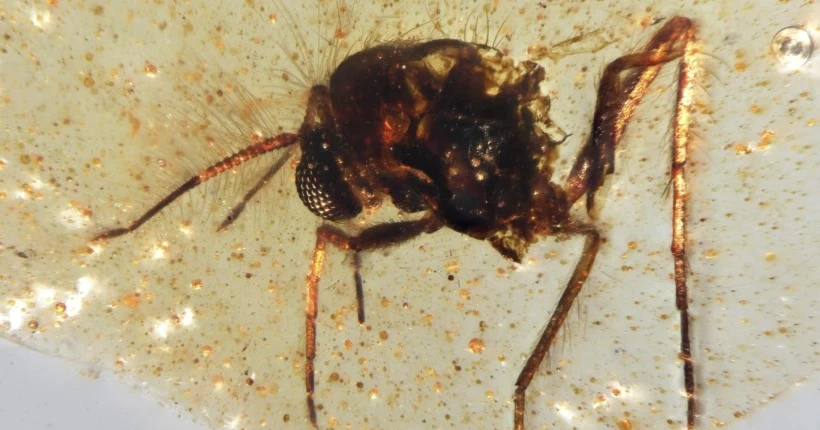
Scientists have identified prehistoric insects preserved in amber in South America for the first time, offering rare insight into life on Earth more than 100 million years ago, when flowering plants were just beginning to spread across the globe.
The discovery was made at a sandstone quarry in Ecuador, with many of the amber specimens dating back about 112 million years, said Fabiany Herrera, curator of fossil plants at Chicago’s Field Museum and co-author of the study published Thursday in Communications Earth and Environment.
Until now, almost all amber deposits from the past 130 million years had been found in the Northern Hemisphere. Their absence in southern regions of the ancient supercontinent Gondwana had long puzzled scientists, said David Grimaldi, an entomologist at the American Museum of Natural History who was not involved in the research.
For the first time, researchers have found fossilized beetles, flies, ants and wasps in South American amber, confirmed Ricardo Pérez-de la Fuente, a paleoentomologist at Oxford University Museum of Natural History.
“Amber pieces are little windows into the past,” Pérez-de la Fuente said, noting that the find will help scientists trace the early interactions between flowering plants and insects during the dinosaur era.
The team uncovered hundreds of amber fragments containing insects, pollen and tree leaves at the quarry, which lies on the edge of today’s Amazon basin. But Herrera said the prehistoric rainforest looked very different from the one we know now, with ferns and conifers — including the distinctive Monkey Puzzle Tree — that no longer exist in the region.
“The forest back then was not like the Amazon we see today,” Herrera explained.
The amber deposits had been known to local geologists and miners for years. Study co-author Carlos Jaramillo of the Smithsonian Tropical Research Institute first learned about them a decade ago and later pinpointed their location through field notes.
“I realized this place is extraordinary,” Jaramillo said. “There’s so much amber in the mines, and it’s easier to spot in the open quarry than in dense forest cover.”
Scientists plan further analysis of the amber to shed light on Cretaceous biodiversity — particularly how insects shaped the evolution of flowering plants.
“Amber tends to preserve the tiniest of details,” said Grimaldi. Pérez-de la Fuente added: “This was the period when insects and flowering plants began their relationship — and that turned into one of nature’s most successful partnerships.”