Scientists recently uncovered a surprising new insight about our solar system — not through a telescope, but during the creation of a planetarium show.
While developing the show Encounters in the Milky Way at the American Museum of Natural History last fall, researchers noticed something unexpected while rendering a scene featuring the Oort Cloud — a distant, icy region beyond Pluto thought to be filled with the remnants of the early solar system.
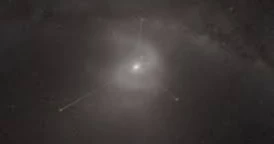
During a test projection on the planetarium dome, museum scientist Jackie Faherty spotted an unusual spiral shape in the inner Oort Cloud. It looked more like the structure of the Milky Way than the spherical or shell-like form scientists previously believed the cloud to have.
“I asked, ‘Why is there a spiral there?’” Faherty recalled.
This inner region of the Oort Cloud — comprised of countless comets — appeared to form a bar with two curved arms, challenging existing theories. To investigate, the museum reached out to planetary scientist David Nesvorny, who had supplied the data used in the animation. He too was surprised by the shape that emerged.
“It was kind of a lucky accident,” said Nesvorny, of the Southwest Research Institute.
Realizing the potential significance, the team published their discovery in The Astrophysical Journal earlier this year. The findings mark a major shift in understanding the outer edges of the solar system, according to planetary scientist Andre Izidoro of Rice University, who wasn’t involved in the research.
Though difficult to confirm with direct observation, the spiral-like structure — revealed through simulations of celestial motion — opens new possibilities for studying cometary orbits and the early solar system.
The unexpected discovery came during the creation of a show meant to educate and inspire. Narrated by actor Pedro Pascal, the production includes stunning visualizations, such as the ongoing merger between the Milky Way and the Sagittarius dwarf galaxy.
According to Carter Emmart, who helped lead the project, the show’s scientific accuracy is what ultimately led to the breakthrough.
“You never know what you’ll discover,” he said.