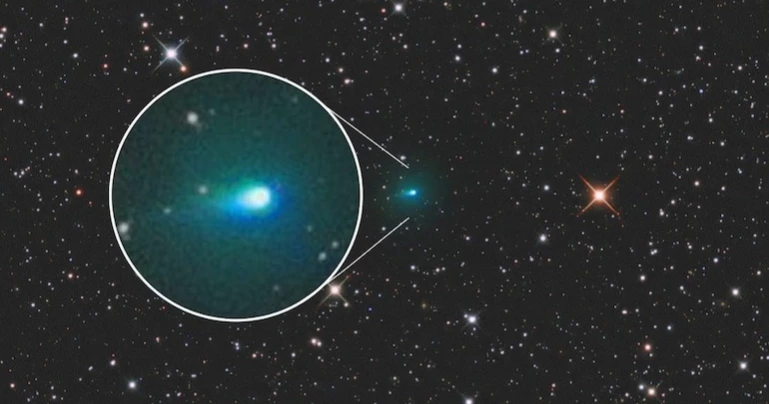
A comet from another star system, 3I/Atlas, made its closest approach to Earth this week, passing safely at a distance of 167 million miles (269 million kilometers). Discovered in July by NASA’s Atlas telescope in Chile, the comet is estimated to be between 440 meters and 5.6 kilometers in size.
NASA continues to monitor the icy visitor with its space telescopes, although the comet is fading as it exits the solar system, offering backyard astronomers a final chance to observe it. Scientists note that 3I/Atlas will pass much closer to Jupiter in March, within 33 million miles (53 million kilometers), before heading back to interstellar space, not to return for thousands of years.
This is only the third known interstellar object to pass through our solar system. Unlike comets like Halley’s, which originate from the solar system’s outer regions, interstellar comets come from star systems elsewhere in the Milky Way. Experts believe 3I/Atlas may have formed in a star system much older than our own, making it a rare and intriguing subject for study.
Previous interstellar visitors include the first confirmed object discovered in Hawaii in 2017, followed by a comet spotted by a Crimean amateur astronomer in 2019. Scientists continue to study these celestial travelers to better understand the broader cosmos.