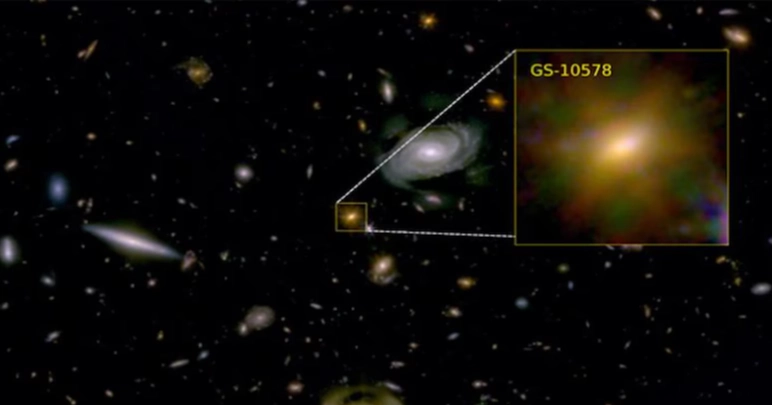
Astronomers using the James Webb Space Telescope and the Atacama Large Millimeter Array have uncovered how a distant galaxy known as “Pablo’s Galaxy” was slowly starved to death by its own supermassive black hole.
The findings, published in the journal Nature Astronomy, show that the galaxy, officially named GS-10578, lost the cold gas needed to form new stars after repeated outbursts from the black hole at its centre.
Pablo’s Galaxy, located about 11 billion light-years away, was once a massive and active star-forming system roughly three billion years after the Big Bang. Scientists estimate it had a mass equivalent to about 200 billion suns.
Researchers found that powerful winds driven by the black hole pushed gas out of the galaxy at speeds of up to 2.2 million miles per hour, gradually draining its fuel supply in what they described as a “death by a thousand cuts.”
Observations from ALMA detected no carbon monoxide in the galaxy, a key indicator of cold, star-forming gas, confirming that it has been almost completely depleted.
The galaxy is currently losing about 60 solar masses of gas every year and could exhaust its remaining fuel within 16 million to 220 million years, scientists said.
Despite its decline, Pablo’s Galaxy remains a calm, rotating disc, suggesting it did not suffer a major collision with another galaxy. Instead, repeated episodes of black hole activity likely prevented fresh gas from returning and restarting star formation.
Scientists say the discovery helps explain why the James Webb telescope has spotted many “old-looking” galaxies in the early universe and suggests that slow starvation by supermassive black holes may be a common process.
With inputs from NDTV